Every morning, millions of Karachi families turn on their taps with a simple, silent assumption: that the water flowing out is safe. They drink it, cook with it, wash their children’s food in it, and fill their baby bottles from it. It is a trust built on routine — and in Karachi, it is a trust that is often quietly, invisibly broken.
The water stored in your rooftop tank did not leave the KWSB treatment plant dirty. It was treated. But by the time it travels through Karachi’s aging distribution network, sits in an unclean storage tank for hours or days, and passes through pipes that may not have been inspected in years — it may reach your tap carrying bacteria, parasites, heavy metals, and chemical residues that no amount of boiling can fully address.
The frightening truth is that the warning signs are rarely dramatic. Contaminated water usually looks normal. It often smells fine. And it tastes like water. This is precisely what makes it so dangerous — and why so many Karachi families continue drinking it without ever realising they are the source of their own recurring illnesses.
This guide is designed to change that. We’ll walk you through the specific hidden health risks lurking in Karachi water tanks, the concrete warning signs that your water may already be compromised, and the steps you need to take today to protect your family.
The Karachi Water Reality: Why Your Tank Carries More Risk Than You Think
To understand why water tank contamination is such a serious issue in Karachi specifically, you need to understand the infrastructure your household water supply actually travels through.
Karachi draws its water primarily from the Indus River and the Keenjhar Lake, treated at facilities including the Dhabeji and Gharo pumping stations. In theory, this water is treated to safe standards before distribution. In practice, the journey from treatment plant to your rooftop tank passes through one of the most overburdened, underfunded, and deteriorating water distribution systems in South Asia.
Here is what happens before that water reaches your tank:
- Pipe age and leakage: Karachi’s water mains include pipes that are decades old, with widespread cracking, joint failures, and illegal connections. Studies by PCRWR have found that cross-contamination between water supply pipes and sewage lines is common in multiple Karachi districts — meaning sewage can enter your mains water supply before it even reaches your neighbourhood.
- Intermittent supply and vacuum contamination: Because KWSB supply is often available only a few hours per day, pressure in the pipes drops to zero between supply periods. This creates a vacuum effect that draws surrounding groundwater, soil water, and in worst cases sewage, into the pipe through cracks and joints. When the supply returns, this contaminated water travels directly into your storage tank.
- Tanker water risk: Millions of Karachi households supplement KWSB supply with tanker water, especially in areas like Orangi Town, Baldia Town, Surjani Town, and parts of Lyari. Tanker water is frequently sourced from unregulated borewells or even directly from contaminated nallahs. It enters your tank without any treatment whatsoever.
- Tank age and construction: Most Karachi rooftop tanks are made from LLDPE plastic or fibreglass. Over time, UV exposure, heat cycles, and water pressure cause micro-cracking in tank walls. Sediment, biofilm, and scale accumulate inside. Older tanks — particularly those more than 5–8 years old that have never been professionally cleaned — may have years of accumulated contamination that continuously recontaminates every fresh water fill.
| ⚠️ Karachi-Specific Risk Factor A 2022 study published in the Journal of Water and Health found that over 73% of household water samples collected from low-to-middle-income neighbourhoods in Karachi showed faecal coliform contamination. Even in higher-income areas like Gulshan-e-Iqbal and North Nazimabad, contamination rates exceeded 40%. The source in most cases was traced to the household storage system — not the original supply. |
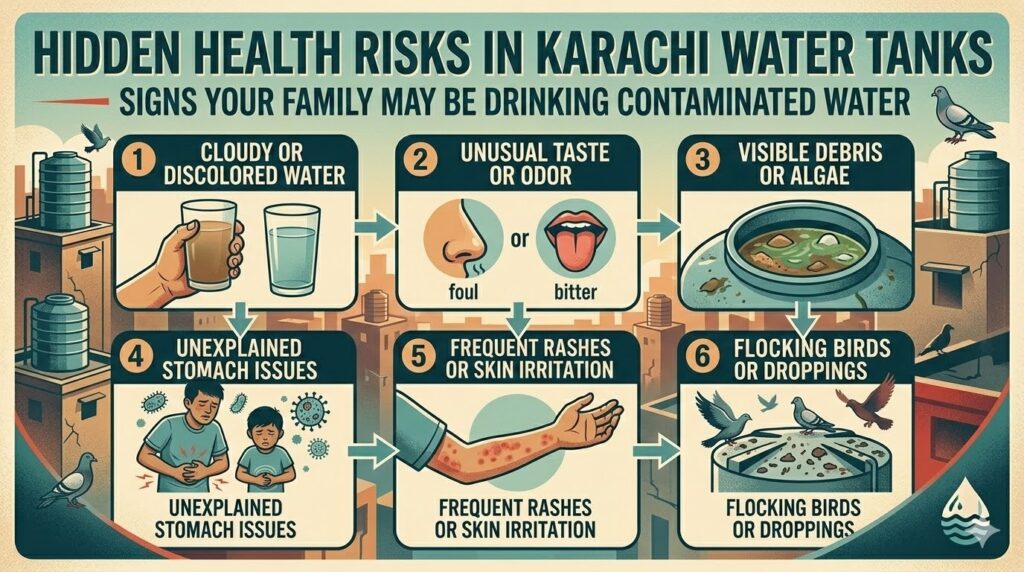
10 Warning Signs Your Karachi Water Tank May Be Contaminated
You don’t need a laboratory to suspect something is wrong. These are the warning signs that experienced water safety professionals — and the families who have learned the hard way — know to watch for.
1. Recurring Gastrointestinal Illness in the Household
This is the single most reliable indicator that your household water supply may be contaminated. If one or more family members regularly experience stomach cramps, loose stools, nausea, vomiting, or diarrhoea without a clear dietary explanation, waterborne pathogens should be suspected.
The pattern to look for is household-wide or household-concentrated illness: multiple family members affected repeatedly, with symptoms that resolve when travelling away from home (such as visiting relatives in another area) and recur on return. This pattern strongly suggests the water supply — not a shared meal — is the source.
Children under 5 are particularly vulnerable. In Karachi, rotavirus, typhoid, and cholera outbreaks are regularly linked to household water contamination. If your child has frequent stomach upsets with no clear cause, have your water tested and your tank inspected immediately.
2. Water That Smells of Chlorine — But Not Consistently
A faint chlorine smell in tap water is actually reassuring — it means residual disinfectant from the treatment process is still present. What should concern you is water that sometimes smells of chlorine and sometimes does not. Inconsistent chlorine levels suggest that the disinfectant residual is being consumed by organic matter inside your storage tank — which means organic contamination (bacteria, algae, biofilm, or faecal matter) is present.
3. A Musty, Earthy, or Sulphurous Smell
A musty or earthy odour in your tap water is characteristic of algae growth or the presence of geosmin — a compound produced by certain bacteria that thrive in warm, stagnant, poorly sealed tanks. Karachi’s climate, with summer temperatures regularly exceeding 38°C, accelerates bacterial and algal growth dramatically in rooftop tanks that receive direct sunlight.
A sulphurous or “rotten egg” smell indicates the presence of hydrogen sulphide gas, produced by sulphur-reducing bacteria in anaerobic conditions — a sign of severe organic contamination at the bottom of the tank.
4. Discoloured Water (Yellow, Brown, Grey, or Greenish Tinge)
Any visible discolouration in your tap water is a serious red flag:
- Yellow or brown: Indicates iron or manganese contamination (common in Karachi borewell water), rust from corroded pipes, or high levels of suspended organic matter
- Greenish tinge: Almost always indicates algae growth inside the tank — particularly common in translucent plastic tanks exposed to sunlight
- Grey or milky: Can indicate high levels of suspended solids, bacteria colonies, or air entrainment from pipe pressure issues
- Reddish sediment: Suggests corroded iron pipes upstream or iron-rich borewell water that has not been filtered
5. White or Grey Scale Deposits on Taps, Kettles, and Shower Heads
Karachi’s water is notoriously hard, meaning it contains high levels of dissolved calcium and magnesium. While mineral scale itself is not directly a health risk, heavy scaling indicates that your water has very high dissolved mineral content — and in tanks where this mineral-rich water sits stagnant, it creates conditions that support bacterial biofilm formation. The scale deposits you see on your kettle represent the same process happening inside your tank walls.
6. An Oily or Chemical Film on Boiled Water
If you notice a thin film or sheen on the surface of water after boiling, this can indicate the presence of hydrocarbons, industrial solvents, or other chemical contaminants. In areas of Karachi near industrial zones (SITE, Korangi Industrial Area, Landhi), chemical contamination of groundwater — which feeds many tankers and borewells — is a documented concern. Chemical contamination is particularly dangerous because boiling does not remove it; it can actually concentrate it.
7. Unexplained Skin or Eye Irritation After Bathing
If family members regularly experience skin rashes, itching, dryness, or eye irritation after bathing or washing, this can indicate chemical contamination (excess chlorine by-products, industrial pollutants) or high levels of bacteria and algae in the water. Children and those with sensitive skin or eczema are most likely to show these symptoms first.
8. Hair Loss or Brittle Hair and Nails
Chronic exposure to water with elevated heavy metal content — arsenic, lead, mercury, or cadmium, all documented in various Karachi water sources — can manifest as hair thinning and loss, brittle nails, and skin changes. These symptoms are insidious because they develop slowly and are easy to attribute to stress, diet, or other factors while the real cause — your water supply — goes unaddressed.
9. Visible Sediment, Particles, or Floating Matter in Water
Any visible particles, flakes, or floating material in your tap water should be treated as a serious warning. Sediment in tap water can include sand and silt (from poorly filtered tanker water or mains leaks), rust flakes (from corroded pipes), algae clumps, biofilm fragments from inside the tank, and — in severe cases — insect larvae or other biological matter from an unsecured tank.
10. Your Tank Has Never Been Professionally Cleaned
If you cannot recall the last time your tank was professionally drained, scrubbed, disinfected, and inspected — or if the honest answer is “never” — then your tank is contaminated. This is not a possibility. It is a near-certainty. Over time, every water storage tank accumulates sediment at the bottom, develops biofilm on its walls, and becomes a reservoir for bacteria. The only question is how contaminated yours is.
The Hidden Pathogens: What’s Actually Growing in an Unclean Tank
When homeowners imagine water contamination, they often picture something dramatic — visibly dirty water, an obvious smell. The reality is subtler and far more dangerous. Here are the specific pathogens most commonly found in unclean Karachi water tanks, and what they do to the human body:
- Typhoid (Salmonella typhi): Karachi consistently records among the highest typhoid rates of any city in the world, including extensively drug-resistant (XDR) typhoid. The WHO has identified Karachi as a global XDR typhoid epicentre. A significant proportion of household transmission is linked to contaminated water storage. Symptoms include sustained high fever, severe headache, weakness, abdominal pain, and can progress to intestinal perforation if untreated.
- Hepatitis A and E: Both hepatitis A and E are transmitted primarily through contaminated water and food. Hepatitis E in particular is endemic in Karachi and causes disproportionately severe disease in pregnant women, with mortality rates up to 25% in the third trimester. Both viruses can survive in water storage tanks for extended periods.
- Cholera (Vibrio cholerae): While cholera outbreaks in Karachi tend to be seasonal and linked to flooding events (particularly in areas like Keamari, Orangi, and Malir during monsoon), the Vibrio cholerae bacterium can persist in household water tanks and cause sporadic household-level illness outside outbreak periods.
- Cryptosporidium and Giardia: These protozoan parasites are particularly dangerous because they are highly resistant to chlorine disinfection. Cryptosporidiosis causes prolonged, severe watery diarrhoea that can last weeks, particularly in children and immunocompromised individuals. Giardia causes chronic digestive disruption, malabsorption, and fatigue that can persist for months. Both are found in Karachi water tank samples.
- Lead and arsenic: Chemical contamination is the silent threat that receives far less attention than biological contamination. Karachi’s aging pipe infrastructure includes lead-containing solder and fittings. Borewell water in multiple Karachi areas has tested above WHO safe limits for arsenic. Chronic exposure to even low levels of lead causes irreversible neurological damage in children — lowered IQ, behavioural problems, and developmental delays. There is no safe threshold for childhood lead exposure.
- Biofilm bacteria (Pseudomonas, Legionella): The sticky biofilm that forms on tank walls is not merely unsightly. It harbours communities of dangerous bacteria, including Pseudomonas aeruginosa (a major cause of infections in wounds and the urinary tract) and, in warm climates, Legionella pneumophila — the bacterium that causes Legionnaires’ disease, a severe and potentially fatal form of pneumonia.
Why Boiling Water Is Not Enough
The most common response Karachi homeowners give when asked about water safety is: “We boil it.” Boiling is valuable — it kills most bacteria and viruses. But it has significant limitations that are poorly understood:
- Boiling does not remove chemical contaminants. Lead, arsenic, pesticides, industrial solvents, and nitrates are not destroyed by heat. In fact, boiling concentrates them by reducing water volume while leaving dissolved chemicals behind.
- Boiling does not remove sediment or particulates. Physical particles, rust, sand, and algae fragments remain in boiled water.
- Boiling does not address the tank. If your tank is the source of contamination, boiling the water after it leaves the tank is downstream protection. The biofilm, sediment, and pathogens in the tank continue to contaminate every batch of new water that enters it. You are treating a symptom, not the cause.
- Water used for washing and bathing is not boiled. Children washing hands, brushing teeth, bathing — all of this uses unboiled tank water. Pathogens absorbed through the skin, inhaled as aerosols in the shower, or accidentally ingested during hand-washing or tooth-brushing represent a continuous exposure route that boiling does not address.
Boiling your drinking water while leaving your tank uncleaned is the equivalent of wiping the outside of a dirty cup while continuing to drink from it. It is better than nothing — but it is not protection.
How Often Should Karachi Homeowners Clean Their Tanks?
The WHO recommends that household water storage tanks be inspected and cleaned at minimum every 6 months. In Karachi, the following cleaning frequencies are advisable based on your specific situation:
| 🗓️ Recommended Cleaning Schedule for Karachi Homes Every 3 months: Homes receiving tanker water as primary or supplementary supply; tanks on open rooftops with significant bird activity; tanks near industrial areasEvery 4–6 months: Homes on KWSB mains supply with a modern, sealed tank in good conditionImmediately: Any household showing warning signs above; any household with an infant or immunocompromised family member; any tank that has never been professionally cleaned |
Neighbourhood-Specific Risks Across Karachi
While every Karachi household faces water contamination risks, certain neighbourhoods carry heightened risk profiles based on infrastructure, water source, and environmental factors:
- Orangi Town, Baldia Town, Surjani Town: Heavy reliance on tanker water; documented borewell contamination; high density housing with older tank infrastructure; historically among the highest rates of waterborne illness in the city
- Lyari, Keamari, Maripur: Proximity to industrial and port activities; elevated risk of chemical contamination in groundwater; older residential stock with aging pipes and tanks
- Korangi, Landhi, SITE Industrial Area surroundings: Industrial effluent contamination of local groundwater is a documented concern; tanker water sourced from borewells in these areas may carry industrial chemical residues
- Gulshan-e-Iqbal, North Nazimabad, Nazimabad: Middle-income areas with moderate KWSB coverage but significant variation in supply pressure; intermittent supply creates vacuum contamination risk in pipes; biofilm accumulation in tanks is the primary concern
- Clifton, DHA, Bahadurabad: Higher-income areas with better infrastructure but not immune to risk; high-rise buildings with large, multi-tank systems that are rarely professionally inspected; extended water storage periods in large tanks create ideal conditions for biofilm and bacterial growth
- Malir, Shah Faisal Colony, Landhi: Flooding vulnerability during monsoon months creates seasonal contamination spikes; surface water infiltration into mains supply and open tanks is a documented risk
What Does a Professional Tank Cleaning Actually Fix?
Understanding exactly what a professional cleaning addresses helps clarify why it is irreplaceable — and why regular cleaning is an investment in your family’s health, not merely a household chore.
A properly conducted professional water tank cleaning service in Karachi eliminates contamination at every level:
- Sediment and sludge removal: Every tank accumulates settled solids at the bottom over time — sand, organic matter, rust particles, and dead microorganisms. This sediment is a reservoir of pathogens and chemical contaminants. Full draining and high-pressure washing removes it entirely.
- Biofilm elimination: The thin, sticky layer of bacteria on tank walls — biofilm — is the primary ongoing source of water recontamination. It resists simple rinsing and requires mechanical scrubbing combined with food-safe disinfectants to fully remove.
- Algae treatment: Green or black algae on tank walls is not just cosmetic. Certain algae species produce toxins (cyanotoxins) that cause liver damage and neurological symptoms. Algae is killed and removed with appropriate disinfectant treatment.
- Tank inspection and repair identification: A professional inspection identifies cracks in the tank body, damaged lids, corroded fittings, and unsealed pipe entry points that allow contamination — providing actionable information to prevent future contamination.
- WHO-approved disinfection: Food-safe disinfectants applied to tank surfaces kill residual bacteria, viruses, and protozoa, including organisms resistant to household chlorine treatment. The tank is then properly rinsed before refilling.
The result is not just clean-looking water — it is water that is genuinely, measurably safer. Families who invest in regular household tank cleaning and maintenance in Karachi report significant reductions in household gastrointestinal illness, particularly in young children.
What You Can Do Right Now: A Quick Home Assessment
Before calling a professional, conduct this quick self-assessment of your tank situation:
- When was your tank last professionally cleaned? If you don’t know, or if it has been more than 6 months, it needs cleaning now.
- Is your tank lid intact, tight-fitting, and fully sealed? Inspect it today. Cracked or missing lids are the single most common entry point for birds, insects, dust, and airborne contaminants.
- Are your inlet and overflow pipes screened or covered? Unprotected pipes allow birds, insects, and debris to enter the tank during and between fill cycles.
- Is your tank opaque or transparent? Clear or semi-transparent tanks allow sunlight penetration, which dramatically accelerates algae growth. Opaque tanks are significantly safer.
- Do you use tanker water? If yes, your risk profile is significantly elevated. Request your tanker supplier’s water source and consider water testing.
- Have family members experienced any of the symptoms described above? If yes, your water supply should be considered a possible cause until ruled out.
If your assessment reveals any concerns, the safest and most effective next step is professional tank cleaning and inspection.
Your Family Deserves Safe Water. Today.
Contaminated water does not announce itself. It doesn’t turn a dramatic colour or announce its presence. It simply, quietly, makes your family unwell — slowly enough that the connection goes unnoticed for months or years. Recurring stomach bugs dismissed as “something they ate.” Persistent tiredness written off as stress. A child who always seems to be fighting something. These may not be bad luck. They may be your water tank.
The good news is that the solution is straightforward. KarachiTankCleaning.com provides professional, certified water tank cleaning services across all major Karachi neighbourhoods — from DHA and Clifton to Orangi Town and Gulshan-e-Iqbal. Our trained teams use industrial-grade equipment and WHO-approved, food-safe disinfectants to deliver a thorough 5-step cleaning process that makes your tank genuinely safe, not just visually clean.
Here is what you get when you book with us:
- ✅ Complete tank draining, scrubbing, and high-pressure washing
- ✅ Full biofilm, algae, and sediment removal
- ✅ WHO-approved food-safe disinfection
- ✅ Thorough tank inspection with written findings
- ✅ Advice on bird-proofing and preventive maintenance
- ✅ Service available for homes, apartments, offices, and commercial properties
- ✅ Coverage across all major Karachi areas
- ✅ Transparent pricing — no hidden fees
| 🛡️ Don’t Wait for Illness to Prompt Action The cost of a professional tank cleaning is a fraction of a single visit to a Karachi private clinic — and a fraction of the cost of treating typhoid, hepatitis, or heavy metal poisoning. Protecting your family’s water supply is not an expense. It is the most practical health decision you can make today. Book your professional cleaning now at KarachiTankCleaning.com — and give your family the water they deserve. |
👉 Book Your Professional Tank Cleaning at KarachiTankCleaning.com 👈
Because every family in Karachi deserves to drink water that is truly safe.
© 2026 KarachiTankCleaning.com | Health & Water Safety Resources for Karachi Homeowners