
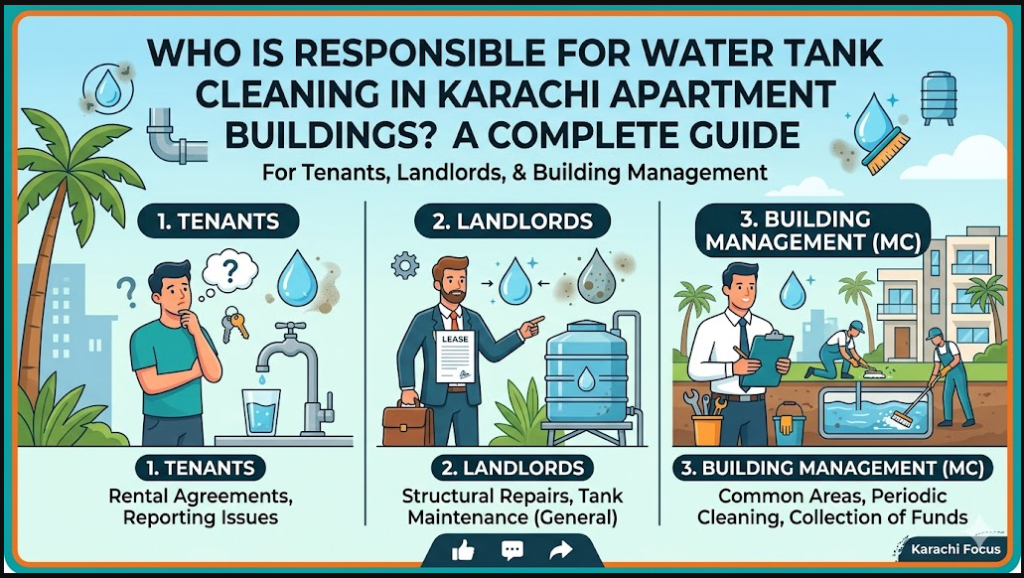
In a Karachi apartment building, the shared water tanks are the responsibility of whoever controls the building’s common areas: the residents’ union or management committee where one exists, the landlord where one person owns the building, and all the flat owners jointly where there is neither. A tenant is responsible only for a tank that serves his or her flat alone. No law spells this out tank by tank, which is why so many shared tanks go years without cleaning.
We clean apartment building tanks across the city and this question comes up often. This guide explains how responsibility divides in practice, what the rent law offers a tenant, how to get a reluctant landlord or committee to act, and what a shared tank cleaning involves. It is general information, not legal advice.
Why Apartment Water Tanks Are a Completely Different Problem
A house has one family, one underground tank and one overhead tank. If the water goes bad, the family knows whose job it is.
An apartment building has a large underground tank that receives line or tanker water, a pump, and one or more roof tanks that feed every flat by gravity. Dozens of families drink, cook and bathe with the same stored water.
- The stakes are higher. One contaminated tank affects every household at once.
- The tanks are bigger and work harder. More water passes through, more sediment settles, and tanker deliveries are frequent.
- Nobody sees them. The underground tank is in the basement or car park and the roof is locked.
- Nobody owns the problem. Each party assumes another is handling it.
- The vulnerable are always present. In any building there are babies, pregnant women and elderly residents.
The water arriving at the building is often unsafe to begin with. In 2017, 107 of 118 Karachi samples tested by the Pakistan Council of Research in Water Resources were unfit to drink (Dialogue Earth). A water board official said at the time that residents had to play their part by keeping their underground storage clean, and asked how often residents of high-rises, mosques and hospitals actually have their tanks cleaned.
The Legal Reality: What the Law Does and Does Not Say
What it does not say
We know of no federal or Sindh law that names who must clean a shared water tank or how often. The Karachi Water and Sewerage Corporation is responsible for supply up to the building’s connection. Building regulations deal with how a building is designed and constructed, not with how its tanks are maintained afterwards. Environmental law is aimed at polluters. The tank in your car park falls between them. See government regulations on water quality in Karachi.
What it does say for tenants
The Sindh Rented Premises Ordinance, 1979 gives tenants two relevant protections (text):
- Section 11, amenities. A landlord may not discontinue an amenity such as water without the tenant’s consent. A tenant can apply to the Rent Controller, who can order it restored and, if the landlord does not comply, arrange restoration and recover the cost from the landlord.
- Section 12, repairs. Where a landlord fails to make necessary repairs, the tenant can apply to the Rent Controller, who may after inquiry allow the tenant to carry them out and deduct the cost from the rent.
Whether cleaning a fouled shared tank counts as a “necessary repair” has to be argued case by case, and the route runs through the Controller, not through a tenant deciding alone to withhold rent. If it comes to that, speak to a lawyer first.
What usually decides it
In practice, three documents matter more than any statute: the tenancy agreement, the building’s union or association rules, and the sale or sub-lease deed for owned flats. Most are silent about tanks. If you are signing a new tenancy or drafting union by-laws, add one line saying who arranges and pays for tank cleaning and how often.
How Responsibility Actually Divides in Practice
| Building type | Who should arrange cleaning | Who pays |
|---|---|---|
| Residents’ union or management committee collects maintenance | The union or committee | Maintenance fund |
| One landlord owns the whole building and rents the flats | The landlord | The landlord, as part of providing a habitable building |
| Flats individually owned, no functioning union | The owners jointly. In practice, whoever takes the lead. | Split between flats |
| A flat has its own separate tank | The occupant of that flat | Tenant or owner, as the tenancy agreement says |
| Shops and offices in a mixed building | Same as above. They use the same tanks and should share the cost. | Split by use |
Scenario 1: Buildings with a Residents’ Association or Building Management Committee (BMC)
Where residents pay a monthly maintenance charge to a union or committee, tank cleaning is the committee’s job. Shared infrastructure is exactly what the charge is for.
It is still neglected, for ordinary reasons. A dirty tank is invisible, unlike a broken lift. Cleaning means a few hours without water, which nobody wants to announce. And the budget gets spent on things residents complain about more loudly.
What works:
- Raise it in writing with the committee, by letter, email or WhatsApp, and ask for the date of the last cleaning and the receipt.
- Ask for it to be put on the agenda of the next meeting, with a quotation attached.
- Propose a fixed schedule, twice a year, with the dates posted on the notice board.
- If the committee does not act, gather signatures from other flats. Committees respond to numbers.
Scenario 2: Buildings with a Single Landlord Who Manages Everything
This is the commonest arrangement. One owner collects rent from every flat and is responsible for the structure and common services. The tanks are part of that, in the same way as the staircase, the pump and the drains.
What works:
- Ask in writing. A WhatsApp message is fine. State the date, when the tank was last cleaned if you know, what you have noticed about the water, and ask for cleaning within 14 days.
- Make it easy. Send a quotation with the request. Landlords agree more readily to a specific figure than to an open-ended demand.
- Ask together. A message signed by several tenants carries more weight than one.
- Offer to share, if the relationship allows. Some tenants prefer to split the cost between flats and get it done.
- Follow up once, in writing, after the deadline.
- If that fails and the water is making people ill, keep your messages, any medical records and photographs, and take advice on an application to the Rent Controller under the ordinance described above.
Scenario 3: Owned Flats in a Mixed Ownership Building
Many older buildings have a different owner for every flat and no working union. Nobody has authority over the shared parts, so nothing happens until one person organises it.
If that person is you, do not open with a discussion about whose responsibility it is. Open with a number.
- Get a quotation for both tanks. We survey apartment buildings free of charge.
- Divide it by the number of flats, or by floor area if flats differ a lot.
- Circulate one message: the total, each flat’s share, the proposed date and who is collecting.
- Collect before the job, keep a simple list of who paid, and share the invoice afterwards.
- Agree there and then to repeat it in six months.
A small, concrete share is far easier to agree to than an abstract argument about duty. Once it has been done once, repeating it is simple.
What Is Actually Growing Inside Your Apartment Building’s Tank Right Now
The Sediment Layer
Silt, sand and rust from the supply and from tankers settle on the floor. In a large tank that receives frequent deliveries, this builds into a thick bed of sludge that is stirred up by every refill.
Biofilm and Algae
A slippery film of bacteria coats the walls and shelters the organisms inside from chlorine. Where light reaches the water, through open hatches or translucent roof tanks, algae grows as well. See preventing algae growth.
Legionella: The Risk Most Karachi Residents Don’t Know About
Large buildings have big volumes of warm, slow-moving water and long pipe runs, which are the conditions Legionella bacteria need. They grow between 20 and 50°C and infect the lungs when people breathe in spray from showers and taps (WHO). Older residents are most at risk. See the Legionella threat in Karachi’s water tanks.
Coliform Bacteria
Coliforms and E. coli show that sewage has reached the water, through the supply line or through cracks in an underground tank that sits near the building’s own drains. They bring the risk of typhoid, hepatitis and diarrhoea. In a shared building, illness tends to appear in several flats within the same few weeks, which is a pattern worth noticing. See waterborne diseases common in Karachi.
How to Actually Determine When Your Building’s Tank Was Last Cleaned
- Ask for the receipt. Do not ask the caretaker “when was it cleaned?” Ask “may I see the receipt from the last cleaning?” A proper service leaves one. No receipt usually means no professional cleaning.
- Look, if you can get access. A recently cleaned tank has clean walls and a visible floor. A neglected one has dark staining, sediment on the floor, slime on the walls and sometimes a green tint.
- Check a glass of water. Fill a clear glass and hold it against a white background in daylight. Haze, colour or particles are warning signs.
- Compare notes with neighbours. Repeated stomach upsets in several flats point to the water.
- Check the lids and covers. An open roof hatch or a broken underground cover tells you how the tank is being looked after.
More in signs your family may be drinking contaminated water.
What a Proper Shared Building Tank Cleaning Actually Involves
People put this off because they imagine days without water. It is hours.
- Survey and quotation. We look at the tanks, access, drains and pump arrangement first. For apartment buildings the survey is free.
- Notice to residents. The union or landlord tells every flat the date and time a day or two ahead, so people can store water.
- Timing. The job is booked for when the tanks are low, just before supply or a tanker delivery, so little water is wasted.
- Draining. The tanks are pumped out.
- Sludge removal.
- Pressure washing of walls, floor and corners.
- Vacuuming out the waste water.
- Disinfection with a chlorine-based solution, then rinsing.
- Inspection. A representative of the building looks inside before the team leaves. Any cracks, broken fittings or damaged covers our crew has seen are pointed out.
- Refill and return to service.
Large and deep tanks are confined spaces, so the crew brings ventilation, gas detection and a person stationed outside. Building staff should never be sent down with a bucket and a broom. See our safety page and service procedure.
Afterwards the building receives an invoice for its records, and a cleaning certificate where one is needed. Post a copy on the notice board. Some of the apartment buildings we have worked for are listed on our clients page.
How Often Does a Shared Apartment Tank Need Cleaning?
Every 6 months at minimum. Shared tanks deserve at least the same care as a house tank, and usually more, for four reasons:
- Supply quality is variable and often contaminated on arrival.
- Many buildings depend on tankers, whose water is not certified by anyone.
- Karachi’s heat speeds bacterial growth for most of the year.
- Any failure affects dozens of families at once.
Buildings that rely mainly on tanker water should clean every 4 months. Clean immediately after sewage or floodwater enters a tank. The reasoning is set out in how often you should clean your water tank in Karachi, and the best months are in the best time to clean your water tank.
A simple building routine
- Two fixed cleaning months a year, for example April and October.
- One named person, on the committee or the staff, responsible for covers and monthly checks.
- A line in the annual budget.
- Receipts kept in a file and dates posted where residents can see them.
A Practical Template: What to Send Your Landlord or BMC
Copy, adjust and send by WhatsApp, email or letter. Keep a copy.
Dear [name of landlord / union office-bearers],
I am writing to request that the shared water tanks at [building name and address] be professionally cleaned and disinfected.
To my knowledge the tanks were last cleaned on [date / not within the past year / never during my time here]. [Add what you have noticed: colour, smell, sediment, illness in the building.] The same water is used by every flat for drinking, cooking and bathing.
I request that cleaning of both the underground and overhead tanks be arranged within 14 days, and that residents be told the date in advance. I have attached a quotation for your convenience. Please confirm the arrangement within 7 days.
I would also ask that cleaning be scheduled every six months from now on and that the dates be posted for residents.
Regards,
[Name, flat number, phone, date]
If you are writing on behalf of several flats, list the flat numbers. A message from the building reads very differently from a message from one tenant.
Frequently Asked Questions
Is the tenant or the landlord responsible for cleaning the water tank?
For a shared tank, the landlord or the building union, because they control the common parts. For a tank that serves only one flat, it depends on the tenancy agreement, and it usually falls to the occupant.
Can a tenant deduct the cost of tank cleaning from the rent?
Not on his or her own decision. The Sindh Rented Premises Ordinance provides a route through the Rent Controller for necessary repairs a landlord neglects. Take legal advice before deducting anything.
How is the cost divided between flats?
Usually equally, or by floor area where flats differ a lot in size. Shops and offices that use the same tanks should contribute.
How long will the building be without water?
For the hours of the job, plus refilling. With notice, residents store what they need.
What does it cost?
Building tanks vary too much for a fixed rate. We quote after a free survey. House rates are on our charges page for comparison.
Our building has no union. Who do we call?
Anyone can arrange it with the neighbours’ agreement. Get a quotation, divide it, collect, and book.
The Bottom Line
The cleaning itself is quick and not expensive when divided between flats. The obstacle is that everybody waits for somebody else. If you are a landlord or on a committee, the tank is yours to look after. If you are a tenant or an owner, you are entitled to ask, in writing, and to organise your neighbours if nobody answers.
To arrange a free survey and quotation for your building, call or WhatsApp 0313-2796778 or use the contact page. We clean apartment building tanks across Karachi, including Garden, Saddar, Gulistan-e-Johar, Gulshan-e-Iqbal, North Nazimabad and FB Area.
About the author: Ahmar Shoaib is the founder of Karachi Tank Cleaning. He holds a BS in Chemical Engineering from Karachi University and has run the company’s cleaning and disinfection work since 2007. This article follows our editorial policy.
Sources: Sindh Rented Premises Ordinance, 1979, sections 11 and 12; PCRWR testing (2017), reported by Dialogue Earth; WHO fact sheet, Legionellosis.