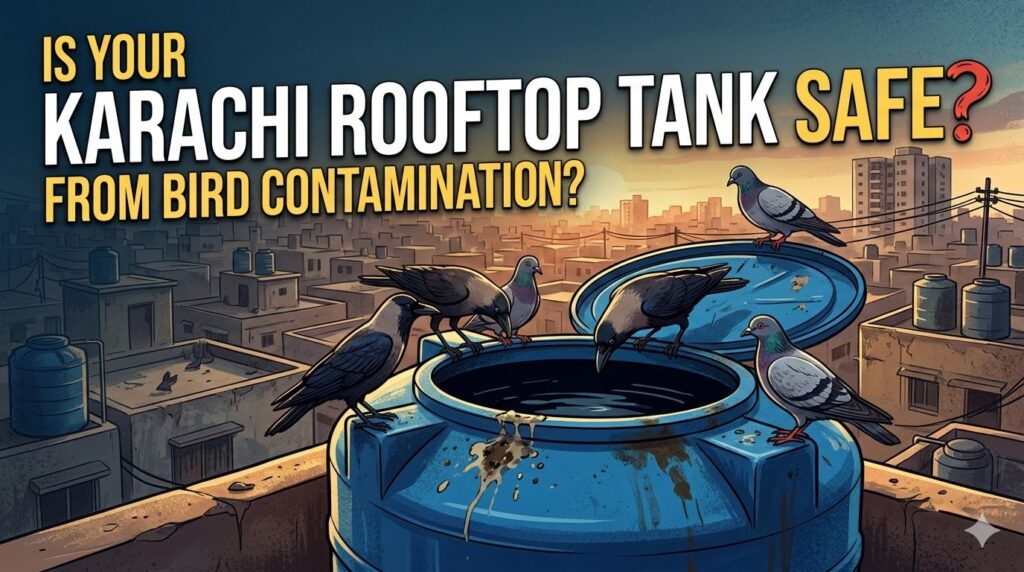
A rooftop tank is safe from birds only if its lid seals, its vent and overflow are covered with mesh, and nothing above it gives birds a perch. If the lid is cracked, loose or missing, assume droppings have reached the water. Bird faeces carry Salmonella, Campylobacter, E. coli and parasites such as Cryptosporidium, and a single dead bird can foul a whole tank. The fix is to clean and disinfect the tank and then close the openings.
Karachi’s roofs are busy with crows, kites, pigeons and mynas, and an open or broken tank lid is a common sight on house roofs. This guide explains how the contamination happens, what the health risk is, how to check your own tank in ten minutes, and how to bird-proof it properly.
Why Rooftop Tanks Attract Birds
- Water. In a hot, dry city, an open tank or a dripping overflow is a drinking and bathing spot.
- Height. Tanks sit at the highest point of the roof, which is where birds like to perch.
- Food nearby. Grain put out for pigeons, meat thrown for kites, and kitchen waste on roofs all bring birds to the same place as the tank.
- Shelter. The gap under a tank stand, behind a tank or inside an open tank is a nesting site.
How Birds Contaminate a Tank
1. Direct Droppings Into Open or Poorly Sealed Tanks
Birds perch on the rim of an open tank or on the lid and defecate. Through a missing lid, a cracked lid or a lid that has shifted, droppings go straight into the water. One bird visiting daily is enough to keep a tank contaminated.
2. Contaminated Runoff From Tank Surfaces
Droppings build up on the lid and shoulders of the tank and dry there. When it rains, or when someone hoses the roof, the run-off carries them through any gap: a loose lid, the hole around an inlet pipe, a cracked shoulder. A tank can look closed and still take in a wash of droppings with every shower.
3. Feathers, Nesting Material, and Dead Birds
Feathers, twigs and nesting material fall in and rot. Birds, especially young ones, fall into open tanks and drown. Kites and crows also drop bones and scraps of meat on roofs and into uncovered tanks. A carcass in warm water decomposes quickly and loads the tank with bacteria.
4. Droppings on Inlet Pipes and Filters
Birds perch on the inlet pipe, the float valve arm and the open ends of vent and overflow pipes. Droppings on these parts are washed into the tank every time it fills. An unscreened overflow pipe is also an entry point for small birds, lizards and insects.
What Bird Droppings Carry
| Organism | Illness in people | How it reaches you |
|---|---|---|
| Salmonella | Diarrhoea, fever, stomach cramps | Drinking or using contaminated water |
| Campylobacter | Diarrhoea, often with fever | Drinking or using contaminated water |
| E. coli | Diarrhoea. A marker of faecal contamination. | Drinking or using contaminated water |
| Cryptosporidium and Giardia | Prolonged watery diarrhoea | Water contaminated with faeces of infected animals or people. Cysts resist chlorine. |
| Histoplasma (a fungus) | Lung infection | Breathing in dust from dried droppings, not from drinking |
Two points are worth separating. The risk from tank water is mainly stomach infection, and it is highest for small children, the elderly and anyone with weak immunity. See how dirty water tanks affect children’s health. The risk from dried droppings on the roof is to the lungs of whoever sweeps them up. The US Centers for Disease Control and Prevention notes that the fungus Histoplasma is found in soil and in bird or bat droppings, and that people are infected by breathing in spores released when contaminated material is disturbed (CDC).
Droppings also feed everything else. They add nitrogen and phosphorus to the water, which speeds up algae and bacterial growth. See preventing algae growth and bacteria in Karachi’s water tanks.
Why it matters more in Karachi
The city’s water is often contaminated before it reaches the roof. In 2017, 107 of 118 samples tested by the Pakistan Council of Research in Water Resources were unsafe (Dialogue Earth). Supply is intermittent, so water is stored for days, and the heat keeps a rooftop tank warm. Anything a bird adds has time and warmth to multiply. See waterborne diseases common in Karachi.
Signs That Birds Have Reached Your Water
- White and grey streaks on the lid, the shoulders of the tank or the inlet pipe
- A lid that is cracked, warped, loose or missing
- Feathers, twigs or seeds floating in the tank or lying on its floor
- A nest behind, under or inside the tank
- A foul or rotten smell from the tank or the taps
- Greenish water or green walls
- Stomach upsets going round the household
Other household signs are covered in signs your family may be drinking contaminated water.
A 10-Minute Rooftop Check
- Lid: is it there, uncracked, and does it screw or clamp down?
- Lid seat: does it sit flat all the way round, with no gap?
- Vent and overflow: is there intact mesh over each open end?
- Inlet hole: is the gap around the inlet pipe sealed?
- Tank body: any cracks on the top or shoulders?
- Above the tank: wires, antenna poles, a parapet or branches that birds perch on?
- Around the tank: droppings, nests, grain or food waste?
- Inside: open the lid and look with a torch for anything floating, sediment or green growth.
Check again after every storm. Most lids are lost to wind.
What to Do If Birds Have Contaminated the Tank
- Stop drinking the water. Boil water for drinking and cooking, or use bottled water, until the tank is dealt with.
- Remove any carcass with gloves, double-bag it and put it out with the rubbish.
- Have the tank drained, scrubbed and disinfected. Chlorine poured into a fouled tank is not enough. The walls and floor have to be cleaned first. See how to disinfect a water tank after cleaning.
- Clean the lid, the outside of the tank and the roof around it. Wet the droppings before removing them and wear a mask and gloves. Do not dry-sweep, because that puts the dust in the air.
- Flush the house pipes by running each tap after the tank refills, and wash or replace filter cartridges.
- Fix the opening the same day.
The underground tank does not need bird-proofing, but it feeds the overhead one, so clean both together. Our crews drain, pressure-wash, vacuum, disinfect and rinse both tanks in one visit, usually in 2 to 4 hours for a house. See the service procedure and the chemicals we use.
How to Bird-Proof a Rooftop Tank
Seal the tank
- Fit a proper lid. Threaded or clamped, from the tank’s maker if possible. A sheet of plywood or a loose tile is not a lid.
- Replace cracked lids immediately. They cost little.
- Mesh the vent and overflow with stainless or plastic mesh fine enough to stop insects, and check it twice a year.
- Seal around the inlet pipe with a grommet or sealant.
- Replace a tank whose top has cracked or gone brittle. See choosing the right tank material.
Make the tank a poor perch
- Bird spikes or a taut wire along the top of the tank, the stand and nearby ledges.
- A sloped cover or canopy over the tank. It also shades the water and keeps it cooler.
- A mesh cage around the tank where birds are persistent.
- Move or shorten perches directly above the tank, such as antenna poles and loose cables.
Remove the attractions
- Feed birds away from the tank. If your household puts out grain or water for birds, do it on a different part of the roof or at ground level.
- Do not leave food waste on the roof.
- Fix dripping overflows and leaks that give birds a water source.
- Clear nests from around the tank outside the breeding season, and block the gaps they were built in.
Do not use poison, glue traps or anything that harms birds. They are unnecessary, and a poisoned bird is as likely to die in your tank as anywhere else. A sealed tank with nothing to perch on solves the problem.
Choose a good location
If you are installing or moving a tank, keep it clear of overhead perches and give it room for a canopy. See choosing the right location for your tank and the benefits of overhead water tanks.
Keeping It Safe
- Check the lid and mesh every month and after every storm.
- Rinse droppings off the top of the tank regularly, with the lid closed tight, so they do not build up.
- Clean and disinfect both tanks every 6 months. See how often to clean your water tank.
- Clean sooner if the lid has been off for any length of time.
The full routine is in how to maintain your water tank after cleaning.
Frequently Asked Questions
Are bird droppings in a water tank dangerous?
Yes. They carry bacteria and parasites that cause stomach infections, and they feed algae and other bacteria in the tank.
A bird died in my tank. Is boiling the water enough?
Boiling makes drinking water safe in the short term. The tank still has to be drained, cleaned and disinfected, because the rest of the house is using that water.
Can I just add chlorine after finding droppings in the tank?
No. Chlorine does not work properly in a fouled tank, and parasite cysts resist it. Clean first, then disinfect.
How do I keep pigeons and crows off my tank?
Seal the lid, mesh the pipes, add spikes or a sloped cover, and remove food and perches near the tank.
Does a closed lid make the tank completely safe?
Only if it seals and the vent, overflow and inlet gap are protected as well. Run-off from a dirty lid finds any gap.
How often should a rooftop tank be cleaned?
Every 6 months, and immediately after any bird contamination.
Rooftop Tank Cleaning in Karachi
If your check turned up an open lid, droppings or anything floating, call or WhatsApp 0313-2796778. We clean and disinfect rooftop and underground tanks across the city, including Tariq Road, PECHS and Bahadurabad. Rates are on our charges page, and under our service guarantee you look inside the tank before you pay.
About the author: Ahmar Shoaib is the founder of Karachi Tank Cleaning. He holds a BS in Chemical Engineering from Karachi University and has run the company’s cleaning and disinfection work since 2007. This article follows our editorial policy.
Sources: CDC, pages on histoplasmosis and Cryptosporidium; PCRWR testing (2017), reported by Dialogue Earth.