
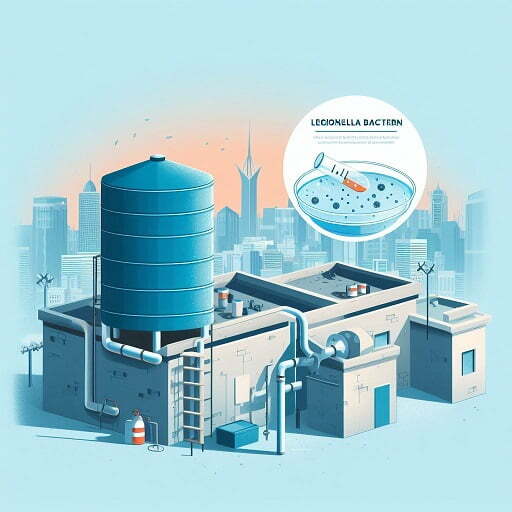
Legionella are bacteria that grow in warm, stagnant water and cause a serious form of pneumonia called Legionnaires’ disease when people breathe in contaminated water droplets. They multiply between 20 and 50°C, fastest at about 35°C, which is the temperature of a rooftop tank in Karachi for much of the year. The risk is controlled by keeping tanks clean, keeping water moving, storing hot water hot, and disinfecting on a schedule.
Legionnaires’ disease is rarely tested for in Pakistan, so nobody knows how common it is here. This article sets out what is known about the bacteria, why local conditions favour them, and the practical steps for homes and buildings.
Legionella Bacteria: What You Need to Know
What they are
Legionella are bacteria that live naturally in rivers, lakes and soil in small numbers. They become a problem inside man-made water systems, where warmth, stagnation and biofilm let them multiply. The name comes from an outbreak at an American Legion convention in Philadelphia in 1976, where the bacterium was first identified.
The illnesses
- Legionnaires’ disease is a severe pneumonia. Symptoms usually begin 2 to 10 days after exposure: fever, cough, shortness of breath, muscle pain and headache, sometimes with diarrhoea and confusion. It needs antibiotics and often hospital care.
- Pontiac fever is a milder, flu-like illness caused by the same bacteria. It clears up in a few days without treatment.
How people catch it
According to the World Health Organization, the most common form of transmission is inhalation of contaminated aerosols from contaminated water, and there is no reported direct human-to-human transmission (WHO). In practice that means breathing the fine spray from:
- showers and taps
- air-conditioning cooling towers
- humidifiers and misting fans
- whirlpool spas and fountains
Drinking contaminated water is not the usual route. The danger is water in the lungs, not in the stomach.
How serious it is
The WHO gives a death rate of 5 to 30% with appropriate treatment, and as high as 40 to 80% in untreated patients with suppressed immunity. Most healthy people who are exposed do not fall ill at all.
Who is most at risk
- People over 50. The WHO notes that 75 to 80% of reported cases are in this group, and 60 to 70% are men.
- Smokers and heavy drinkers
- People with chronic lung disease, diabetes or kidney disease
- People with weakened immunity, including cancer and transplant patients
Legionella Bacteria in Karachi’s Water Tanks
There is very little published data on Legionella in Karachi. Pneumonia is common, and patients are seldom tested for this particular cause, so cases are likely to go unrecognised. What can be said is that the conditions the bacteria need are all present.
- Temperature. Rooftop tanks sit in the sun. For much of the year the water in them is between 25 and 40°C, right in the growth range.
- Stagnation. Supply is intermittent, so water is stored for days. The city gets about 650 million gallons a day against a need of about 1,200 million (Geo News).
- Biofilm and sludge. Tanks that are rarely cleaned have a slimy film on the walls and sediment on the floor. Legionella live inside biofilm, where chlorine does not reach them.
- Little or no chlorine. In 2018, officials told a Supreme Court-appointed commission that not even half of Karachi’s water was filtered (ProPakistani), and whatever chlorine is added fades in hot storage.
- Scale and rust. Hard water deposits give bacteria shelter and nutrients. See Karachi’s hard water problem.
The same conditions favour Naegleria fowleri, another warm-water organism, which causes deaths in Karachi most summers (Dawn). Naegleria is tested for and reported. Legionella mostly is not.
Where the risk is highest
- Hospitals and clinics, because the patients are the most vulnerable people.
- Hotels, hostels and guest houses, with long pipe runs and rooms that stand empty.
- Apartment and office towers with large tanks, long storage and cooling towers.
- Gyms, salons and swimming pools, where showers are used heavily.
- Homes with an elderly or unwell resident, a rarely used bathroom, or a lukewarm geyser.
Factors Contributing to Legionella Growth
| Factor | Why it matters | What to do |
|---|---|---|
| Water at 20 to 50°C | The growth range. About 35°C is ideal. | Shade and insulate cold tanks. Keep hot water hot. |
| Stagnant water | Gives time to multiply and lets disinfectant fade | Size tanks to turn over in a few days. Flush unused taps weekly. |
| Biofilm | Shelter and food | Clean and disinfect tanks every 6 months. |
| Sediment, scale and rust | Nutrients and hiding places | Remove sludge. Descale. Replace rusting tanks and fittings. |
| No disinfectant residual | Nothing to hold numbers down | Disinfect after cleaning. Maintain a measured chlorine residual in large systems. |
| Dead legs | Capped or unused pipe branches hold still water | Remove them, or flush them. |
| Spray-producing outlets | Turn contaminated water into breathable droplets | Clean and descale shower heads. Maintain cooling towers. |
| Lukewarm geysers | Hot water stored at 30 to 45°C is ideal for growth | Store hot water at 60°C. |
The Importance of Legionella Testing
You cannot see, smell or taste Legionella. Clear, pleasant water can carry them.
Who should test
- Hospitals, clinics, dialysis centres and care homes
- Hotels and large residential and commercial buildings
- Any building with a cooling tower
- Any building after a suspected case among its occupants
For an ordinary house, routine Legionella testing is not necessary. Money is better spent on keeping the tanks clean and the geyser hot.
How testing works
A laboratory cultures water samples taken from the tanks, the geyser and the outlets furthest from them, and reports the result as colony-forming units per litre. Sampling has to be done properly, in sterile bottles, and delivered promptly. Ask the laboratory for its sampling instructions, and remember that one clear result is a snapshot, not a guarantee.
Monitoring Water Quality
Between laboratory tests, building managers can track the things that predict Legionella growth.
- Temperature. Measure cold water at the tank and at the far taps, and hot water at the geyser and the outlets. The WHO’s guidance is to keep hot water above 50°C at the tap, which requires water leaving the heater at 60°C or more, and cold water below 25°C.
- Chlorine residual. Test strips or a pool kit. Pakistan’s standard is 0.2 to 0.5 mg/L at the consumer end (S.R.O. 1063(I)/2010).
- Tank condition. Monthly visual check for sediment, slime, rust and lids.
- Usage. A log of rooms, floors or outlets that are out of use, so they can be flushed.
- Records. Dates of cleaning, disinfection, testing and repairs.
Karachi’s climate makes the cold-water target unreachable in summer. A rooftop tank will not stay below 25°C in June. That is why the other controls, cleanliness, turnover and disinfection, matter more here than in a cooler country.
Mitigation and Prevention Strategies
For homes
- Clean and disinfect both tanks every 6 months. This removes the biofilm and sludge the bacteria live in. See how often to clean your water tank.
- Set the geyser to 60°C and do not leave it on a lukewarm setting. Take care with children and the elderly at the tap, because water at that temperature scalds.
- Flush unused outlets. Run the taps and shower in a spare bathroom for a few minutes each week.
- After a long absence, run every tap and shower for several minutes before use, standing back from the spray, and drain and refill the overhead tank if the house was empty for weeks.
- Clean shower heads and tap aerators every few months. Soak them in vinegar to remove scale, then in dilute bleach, and rinse.
- Shade the overhead tank and do not oversize it. See choosing the right size water tank.
- Empty and dry humidifiers, air coolers and misting fans when not in use, and clean them weekly when they are.
For buildings, hotels and hospitals
- Appoint a responsible person and write a simple water safety plan: what is checked, how often, by whom.
- Clean and disinfect all tanks at least every 6 months, and more often where the occupants are vulnerable. For shared buildings, see who is responsible for tank cleaning in apartment buildings.
- Maintain cooling towers under a specialist contract, with regular cleaning, biocide treatment and drift control.
- Keep hot water systems at temperature and circulating.
- Remove dead legs and flush little-used outlets on a schedule.
- Test at intervals suited to the risk, and act on the results.
- Keep records. We give commercial and industrial clients a cleaning certificate stating the date, the tank and the chemical used, for their auditors or the health department.
How tank cleaning helps
Legionella cannot be controlled by chlorine alone, because biofilm protects them. Physical removal has to come first. A proper cleaning drains the tank, removes the sludge, pressure-washes the film off the walls, vacuums out the waste water and then disinfects the bare surfaces. See our service procedure, the chemicals we use, and the guide to disinfecting a tank after cleaning. For other organisms that share the tank, see bacteria in Karachi’s water tanks.
Raising Awareness in Karachi
Three groups can change the picture.
- Doctors, by considering Legionella in severe pneumonia, particularly in older patients and in clusters linked to one building.
- Building owners and managers, by treating water systems as something that needs a plan, not just a pump.
- Households, by cleaning tanks on schedule and running the geyser hot.
None of this is expensive. Most of it is routine upkeep that also protects against the far more common waterborne infections described in waterborne diseases common in Karachi and signs your family may be drinking contaminated water.
Frequently Asked Questions
At what temperature does Legionella grow?
Between 20 and 50°C, with fastest growth at about 35°C. Below 20°C it is dormant, and it does not survive sustained temperatures of 60°C and above.
Can you get Legionnaires’ disease from drinking water?
Not normally. It is caught by breathing in fine droplets of contaminated water, for example in a shower.
Can Legionella spread from person to person?
The WHO reports no direct human-to-human transmission.
Can Legionella grow in an overhead water tank?
Yes, if the water is warm, stored for days and the tank has biofilm or sediment. That describes many rooftop tanks in summer.
Does chlorine kill Legionella?
Chlorine kills free-floating bacteria. It does not reliably reach those inside biofilm, which is why the tank has to be physically cleaned first.
What does the word Legionella mean?
It is named after the American Legion, whose members fell ill at a 1976 convention where the bacterium was discovered. There is no separate Urdu word for it. The illness it causes is a type of pneumonia.
How often should tanks be cleaned to control Legionella?
Every 6 months as a minimum, and more often in hospitals, hotels and buildings with vulnerable occupants.
Tank Cleaning and Disinfection for Homes and Buildings
Call or WhatsApp 0313-2796778. We clean and disinfect tanks for houses, apartment blocks, hotels, hospitals and offices across Karachi, including Saddar, Tariq Road and Bahadurabad. Buildings are quoted after a free survey, which you can request through the contact page, and some of the organisations we have worked for are listed on our clients page.
About the author: Ahmar Shoaib is the founder of Karachi Tank Cleaning. He holds a BS in Chemical Engineering from Karachi University and has run the company’s cleaning and disinfection work since 2007. This article follows our editorial policy.
Sources: WHO fact sheet, Legionellosis (September 2022); PCRWR figures reported by Geo News (May 2025); Judicial Commission on Water and Sanitation proceedings, reported by ProPakistani (January 2018); health officials’ statements on Naegleria fowleri, reported by Dawn (June 2025); National Standards for Drinking Water Quality, S.R.O. 1063(I)/2010.