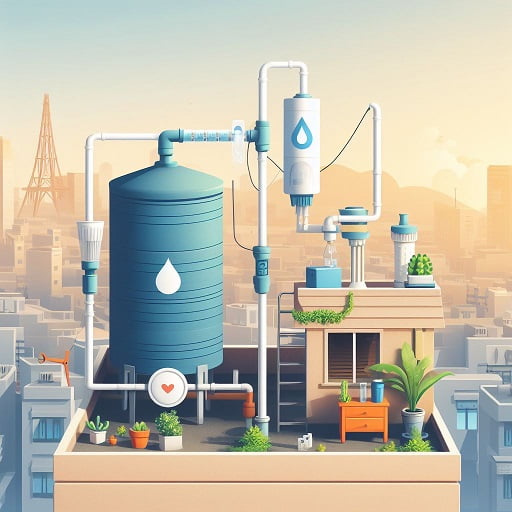
Safe water in a Karachi home takes two things working together: a clean storage tank and the right filter for your water source. For line water, a sediment filter plus ultraviolet (UV) or ultrafiltration (UF) treatment, or simply boiling, deals with the main risk, which is bacteria. For salty boring water, only reverse osmosis (RO) makes it drinkable. No filter makes up for a dirty tank, because the filter treats one tap and the tank supplies the whole house.
This guide explains what is in Karachi’s water, what each type of filter removes and does not remove, how to maintain a filter so it does not become a source of contamination itself, and how filtration and tank cleaning fit together.
Understanding the Importance of Clean Water
UNICEF estimates that 70% of households in Pakistan drink bacterially contaminated water, and that 53,000 children under five die each year from diarrhoea linked to poor water and sanitation (UNICEF Pakistan).
Karachi’s own figures are no better. In 2017 the Pakistan Council of Research in Water Resources (PCRWR) tested 118 samples across the city: 107 were unsafe to drink, 88% had coliform bacteria above WHO limits and a third contained E. coli (Dialogue Earth). In 2018, officials told a Supreme Court-appointed commission that not even half of the water supplied to the city was filtered (ProPakistani).
So the working assumption for any household should be that tap water needs treatment before drinking, whatever it looks like.
Water Contaminants in Karachi
| Contaminant | Where it comes from | Why it matters | Can you see or taste it? |
|---|---|---|---|
| Bacteria, viruses, parasites | Sewage mixing with water lines, dirty tanks, tanker hoses | Typhoid, hepatitis A and E, cholera, diarrhoea | No |
| Sediment and turbidity | Old pipes, supply gaps, tanker water, tank sludge | Shelters germs, clogs filters, stains laundry | Yes |
| Dissolved salts (TDS) | Boring water, seawater intrusion | Salty taste, unfit to drink at high levels, corrodes fittings | Taste |
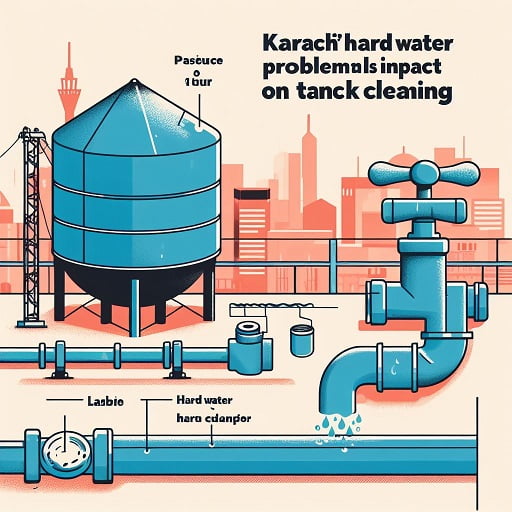
| Hardness | Boring water | Scale in tanks, geysers and kettles | White deposits |
| Chlorine, when present | Added at treatment plants | Protective, but affects taste | Smell |
| Iron and manganese | Groundwater, rusting pipes and tanks | Brown or black staining, metallic taste | Yes |
| Algae and organic matter | Tanks that let in light, rotting sludge | Smell, taste, food for bacteria | Yes |
| Chemical pollutants | Industrial areas, contaminated groundwater | Long-term health effects | Usually not |
The first row is the one that makes people ill this week. The national standard is that E. coli and coliforms must not be detectable in any 100 ml sample (S.R.O. 1063(I)/2010). Related reading: waterborne diseases common in Karachi, Karachi’s hard water problem and the impact of industrialization on water quality.
Types of Water Filtration Systems
| System | Removes | Does not remove | Best for |
|---|---|---|---|
| Sediment filter (PP cartridge) | Sand, silt, rust, visible particles | Bacteria, viruses, salts, chemicals | First stage of every system. Whole-house protection for appliances. |
| Activated carbon | Chlorine, taste, odour, many organic chemicals | Bacteria, salts, hardness | Improving taste. Protecting RO membranes from chlorine. |
| Ceramic candle | Sediment and most bacteria | Viruses, salts, chemicals | Low-cost gravity filters, no electricity |
| Ultrafiltration (UF) | Bacteria, parasites, fine particles | Dissolved salts and hardness. Some viruses pass. | Line water with low TDS. Works without electricity. |
| Ultraviolet (UV) | Kills or inactivates bacteria, viruses and parasites | Removes nothing. Needs clear water and electricity. | Final disinfection after sediment and carbon stages |
| Reverse osmosis (RO) | Dissolved salts, hardness, metals, most chemicals, bacteria and viruses | Wastes part of the water. Also removes useful minerals. | Boring water and any water with high TDS |
| Water softener | Hardness | Bacteria, salts. Adds sodium. | Protecting geysers and plumbing, not for drinking water |
Which one do you need?
- Line water, tastes fine, TDS under about 500: sediment plus carbon plus UV or UF. Or a simple filter and boiling.
- Mixed line and tanker water: the same, with the sediment cartridge changed more often.
- Boring water, salty or TDS above 1,000: RO for drinking and cooking. The national standard for drinking water is below 1,000 mg/L.
- Heavy scale on taps and geysers: add a softener or scale inhibitor on the line to the geyser. See hard water stains and deposits.
- Sediment through the whole house: a whole-house sediment filter after the overhead tank, and a tank cleaning.
A handheld TDS meter costs little and tells you which group you are in. It does not detect bacteria.
A note on RO
RO is the most thorough home treatment and the only one that removes salt. It is also the most often misused. It sends a share of the water to waste, which is hard to justify for water that was not salty to begin with. It strips minerals, so very low-TDS water tastes flat. And a neglected RO unit, with an old membrane and a slimy storage tank, can deliver worse water than it receives. Buy one if your water needs it and maintain it properly.
DIY Water Filtration Methods
Boiling
Bring water to a rolling boil for at least one minute, let it cool covered, and store it in a clean, covered container. Boiling kills bacteria, viruses and parasites. It does not remove salts, chemicals or sediment, so strain cloudy water through a clean cloth first.
Chlorine tablets or drops
Water purification tablets, used exactly as the packet directs, disinfect clear water in about 30 minutes. They are useful during floods and outbreaks. The WHO recommended chlorine tablets as part of the response to drug-resistant typhoid in Sindh (WHO).
Solar disinfection
Clear water in clean, transparent plastic bottles, laid in full sun for at least six hours, is disinfected by ultraviolet light and heat. It suits small quantities when fuel is short. It does not work on cloudy water.
Cloth and settling
Letting water stand and pouring it through a folded clean cloth removes sediment only. It is a first step before boiling, not a treatment in itself.
What does not work
Alum clears muddy water but does not disinfect it. A single sediment cartridge makes water look clean without making it safe. Neither is enough alone.
Why the Tank Comes First
A filter sits at the end of the line. Everything upstream of it decides how hard it has to work.
- The filter treats one tap. You bathe, brush your teeth, wash dishes and vegetables, and make ablution with unfiltered tank water. The amoeba Naegleria fowleri, which causes deaths in Karachi most summers, infects through the nose, not by drinking (CDC). No kitchen filter touches that risk.
- A dirty tank overloads the filter. Sludge clogs sediment cartridges in weeks. Organic matter exhausts carbon. Cloudy water shields bacteria from UV light.
- A dirty tank shortens RO membrane life and fouls the pre-filters.
- Contamination grows in storage. Sindh’s household survey found E. coli in 79.1% of Karachi’s source water and 85.5% of water at household level (Geo News). Some of that increase happens in the tank.
Clean both tanks every 6 months and the filter has an easier, longer life. See how often to clean your water tank, the benefits of regular tank cleaning and our service procedure. The health reasons are in the importance of tank cleaning for health and hygiene.
Maintenance and Cleaning of Water Filtration Systems
A filter collects what it removes. If it is not changed, it becomes a breeding ground and can release more bacteria than it stops.
| Part | Typical interval | Sign it is overdue |
|---|---|---|
| Sediment cartridge | 3 to 6 months, sooner with tanker water | Brown colour, slow flow |
| Carbon cartridge | 6 months | Taste and smell return |
| UF membrane | Flush regularly, replace every 1 to 2 years | Slow flow that flushing does not fix |
| UV lamp | 12 months, even if it still glows | Lamp alarm, or simply the date |
| UV quartz sleeve | Clean every few months | Scale or film on the glass |
| RO membrane | 2 to 3 years | Rising TDS in the filtered water, low output |
| RO storage tank and tubing | Sanitise once a year | Slimy feel, stale taste |
| Ceramic candle | Scrub when flow slows, replace as the maker advises | Cracks, thinning |
Follow your manufacturer’s schedule where it differs. Three further rules:
- Write the date of each change on the housing.
- Wash your hands and the housings when changing cartridges.
- After any tank cleaning, flush the lines and replace the sediment cartridge, which is holding the old dirt.
Water Quality Testing
What to test for
- Total coliforms and E. coli: the most important test for a household. Standard: none detectable in 100 ml.
- TDS: below 1,000 mg/L.
- Turbidity: below 5 NTU.
- pH: 6.5 to 8.5.
- Residual chlorine: 0.2 to 0.5 mg/L at the consumer end.
These are the values in Pakistan’s National Standards for Drinking Water Quality (S.R.O. 1063(I)/2010).
How to test
- At home: a TDS meter and chlorine test strips. A clear glass held to the light shows turbidity.
- At a laboratory: bacterial tests need a lab. PCRWR, university laboratories and private labs in Karachi test household samples. Collect the sample in the sterile bottle the lab provides and deliver it the same day.
When to test
- When you move into a house
- After installing or servicing a filter, to confirm it works
- If someone in the house has repeated stomach illness. See signs your family may be drinking contaminated water.
- After flooding or a sewage smell in the supply
- Once a year as routine, testing both the tap and the filtered water
Government Initiatives and Regulations
Public supply is the responsibility of the Karachi Water and Sewerage Corporation, which replaced the old water board in 2023 (Dawn). It operates filtration plants and chlorinates part of the supply, but the courts and the PCRWR have repeatedly found that much of the city’s water reaches consumers unfiltered or contaminated. A judicial commission in 2017 also found large numbers of government RO plants across Sindh out of order (Dawn).
The quality benchmarks are the national standards quoted above. They apply to suppliers. Inside your gate, the tank and the filter are yours to manage. The legal background is explained in government regulations on water quality in Karachi.
Benefits of Clean Water
- Fewer stomach infections, especially in children. See dirty tanks and children’s health.
- Lower medical bills and fewer missed days of school and work.
- Tea and food that taste as they should.
- Longer life for kettles, geysers and washing machines.
- Less money spent on bottled water.
Frequently Asked Questions
Which water filter is best for Karachi?
It depends on the source. For line water, sediment plus carbon plus UV or UF. For boring water with high TDS, RO.
Do I need RO if I get line water?
Usually not. Line water is low in salt, and its problem is bacteria, which UV, UF or boiling handles without wasting water.
Is boiled water enough?
For drinking, yes, if the water is not salty. Boil for one minute and store it covered.
If I have a filter, do I still need to clean my tank?
Yes. The filter protects one tap. The tank supplies the bathrooms, the kitchen sink and the washing machine, and a dirty tank ruins filters quickly.
Why does my filter clog so fast?
Sediment from tanker water or sludge in your tanks. Clean the tanks and the cartridges will last several times longer.
What TDS is safe for drinking?
Pakistan’s standard is below 1,000 mg/L. Most people prefer the taste of water below about 500.
Start with a Clean Tank
Call or WhatsApp 0313-2796778 to have both tanks cleaned and disinfected before you fit or service a filter. We work across Karachi, including Gulberg, Liaquatabad and Nazimabad. Rates are on our charges page.
About the author: Ahmar Shoaib is the founder of Karachi Tank Cleaning. He holds a BS in Chemical Engineering from Karachi University and has run the company’s cleaning and disinfection work since 2007. This article follows our editorial policy.
Sources: UNICEF Pakistan, WASH programme page; PCRWR testing (2017), reported by Dialogue Earth; Judicial Commission on Water and Sanitation proceedings, reported by ProPakistani (January 2018) and Dawn (March 2017); National Standards for Drinking Water Quality, S.R.O. 1063(I)/2010; WHO Disease Outbreak News, Typhoid fever in Pakistan (December 2018); CDC, About Naegleria fowleri infection; PCRWR and Sindh MICS figures reported by Geo News (May 2025); Dawn (July 2023).