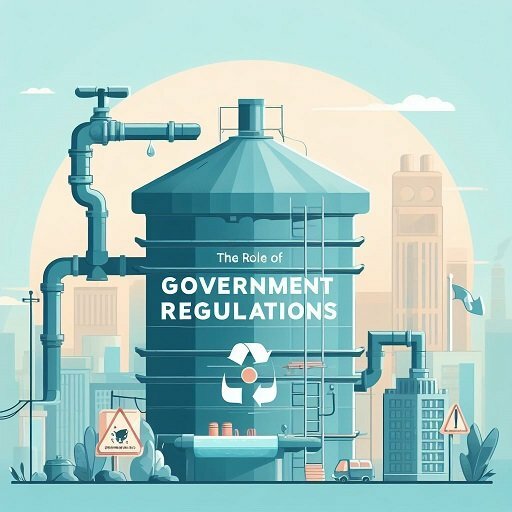
Karachi’s water quality is governed by three layers of rules. The Karachi Water and Sewerage Corporation (KWSC) is responsible for treating and supplying water. Pakistan’s National Standards for Drinking Water Quality set the limits that water should meet. The Sindh Environmental Protection Act, 2014 prohibits pollution of water sources. The courts have stepped in repeatedly to enforce all three. What none of them covers is the last stage of the journey: the private tank where water sits before you drink it.
This article explains each layer in plain language, shows where the system works and where it does not, and sets out what the rules mean in practice for households, landlords and businesses.
Water Quality Issues in Karachi
The scale of the problem is not in dispute.
- Shortage. The city needs about 1,200 million gallons a day and receives about 650 (Geo News).
- Contamination. In 2017 the Pakistan Council of Research in Water Resources (PCRWR) found 107 of 118 Karachi samples unsafe to drink, with coliform bacteria above WHO limits in 88% and E. coli in a third (Dialogue Earth).
- Incomplete treatment. In 2018, filtration plant officials told a Supreme Court-appointed commission that not even half of the water supplied to Karachi was filtered, and that quality testing was done only once every 15 days (ProPakistani).
- Untreated sewage. The city generates about 472 million gallons of waste water a day and treats little more than a tenth of it (Aaj News).
- An informal market. Dawn’s 2023 investigation counted six official hydrants and at least 86 illegal ones drawing from the utility’s pipelines (Dawn).
Regulation exists to deal with each of these. The causes of the pollution itself are covered in the impact of industrialization on water quality in Karachi.
Government Regulations and Their Significance
Who does what
| Body | Role |
|---|---|
| Karachi Water and Sewerage Corporation (KWSC) | Bulk supply, filtration, chlorination, distribution, sewerage, official hydrants |
| Pakistan Environmental Protection Agency | Issued the National Standards for Drinking Water Quality |
| Sindh Environmental Protection Agency (SEPA) | Enforces the Sindh Environmental Protection Act and the Sindh Environmental Quality Standards against polluters |
| Pakistan Council of Research in Water Resources (PCRWR) | Federal research body. Tests and reports on water quality. Not a regulator. |
| Pakistan Standards and Quality Control Authority (PSQCA) | Sets and licenses standards for bottled water |
| Sindh Food Authority | Regulates food businesses, including the water they use |
| Cantonment boards and housing authorities | Distribute water within their own areas |
| Sindh High Court and Supreme Court | Enforce the right to clean water through commissions and orders |
The Karachi Water and Sewerage Corporation Act, 2023
In 2023 the Sindh Assembly replaced the Karachi Water and Sewerage Board with a corporation. The mayor became chairperson, and a chief executive officer is appointed by the board for a four-year term. The law focuses on governance, tariff collection, financial sustainability and the ability to outsource services (Dawn). The aim is a utility that can pay for its own maintenance and be held to account. The law does not create a separate, independent water quality regulator.
National Standards for Drinking Water Quality
These were notified by the Pakistan Environmental Protection Agency in 2010 and are the benchmark for any water supplied for drinking (S.R.O. 1063(I)/2010).
| Parameter | Standard |
|---|---|
| E. coli and total coliforms | Must not be detectable in any 100 ml sample |
| Turbidity | Below 5 NTU |
| Colour | 15 TCU or less |
| Taste and odour | Not objectionable |
| pH | 6.5 to 8.5 |
| Total dissolved solids | Below 1,000 mg/L |
| Total hardness | Below 500 mg/L |
| Residual chlorine | 0.2 to 0.5 mg/L at the consumer end, 0.5 to 1.5 mg/L at source |
| Arsenic | 0.05 mg/L or less |
Two of these rows explain why storage matters. Water should arrive with a small chlorine residual, and it should contain no coliforms. Both conditions are easily lost in a warm, dirty tank.
Sindh Environmental Protection Act, 2014
This Act provides for the prevention and control of pollution in Sindh. Under it, no person may discharge waste or pollutants at levels higher than the Sindh Environmental Quality Standards, and the Sindh Environmental Protection Agency administers and enforces its provisions (summary). It is the law that applies to factories discharging effluent into the Lyari and Malir rivers, and to anyone dumping waste into a drain or water body.
The constitutional position
Pakistan’s superior courts have held that the constitutional right to life includes the right to clean water and a healthy environment. That principle is the basis for the public interest cases described below.
Rules for buildings and businesses
- Buildings. Water tanks are part of the building plan approved under the Karachi Building and Town Planning Regulations.
- Food businesses. Restaurants, bakeries and food factories fall under the Sindh Food Authority, and water used in food preparation is expected to be of drinking quality.
- Bottled water. Brands need a PSQCA licence, and PCRWR publishes periodic test results naming unsafe brands.
- Workplaces. Employers are responsible for providing safe drinking water to staff under labour and factory laws, and many are also audited by their customers.
Impact of Regulations on Water Quality
Where regulation has made a difference
- Standards exist. There is a clear, written definition of safe water against which any sample can be judged.
- Testing is published. PCRWR’s reports and the court commissions’ findings put numbers on the problem.
- Courts have forced action. In 2017 the Supreme Court removed the managing director of the water board after a judicial commission reported that the water supplied to Karachi and Hyderabad was substandard (Dawn). A later commission inspected filtration plants and found vacancies and infrequent testing.
- The utility has been restructured, with the stated goal of financial and operational improvement.
Where it has not
The outcome that matters, safe water at the tap, has not been achieved. Rules on paper have not yet become clean water in pipes.
Challenges and Limitations
- Enforcement. Agencies are short of staff, laboratories and money. Illegal hydrants and untreated industrial discharge continue despite the law.
- Old infrastructure. Standards are met at the treatment plant and lost in leaking pipes that run beside sewers.
- Intermittent supply. Pipes that stand empty draw in contamination. No regulation fixes this without more water.
- Overlapping authorities. The corporation, cantonment boards, housing authorities, provincial and federal agencies each control a part.
- No independent regulator for drinking water quality with powers over the utility.
- Tanker water. A large share of households buy water whose source and quality nobody certifies.
- The last hundred feet. We know of no rule that sets how often a private household tank must be cleaned or tested. The World Health Organization’s technical note explains how to clean and disinfect a tank, not how often (WHO Technical Note 3). Once water passes your meter, its quality is your responsibility.
That last gap is larger than it sounds. Sindh’s household survey found E. coli in 79.1% of Karachi’s water at source and 85.5% at household level, as reported by Geo News. Part of the contamination people drink is added after the regulated system ends.
What the Rules Mean for You
Households
- You are entitled to water that meets the national standards, and you can complain to the utility when it does not, especially when sewage mixes into the supply.
- Your tanks are your responsibility. Clean and disinfect them every 6 months. See how often to clean your water tank.
- Treat drinking water at home. See filtration and cleaning in Karachi homes.
Landlords, builders and apartment unions
- Whoever controls a shared tank controls the water of everyone who uses it. There is no specific statute, but responsibility follows control, and tenancy and maintenance agreements should say who arranges and pays for cleaning. See who is responsible for tank cleaning in apartment buildings.
- Keep records of cleaning dates and any test results.
Restaurants, schools, hospitals and food factories
- Expect inspectors and auditors to ask how water is stored and when tanks were last cleaned.
- Keep a cleaning certificate and invoice for each cleaning, stating the date, the tank and the chemical used. We issue both to commercial and industrial clients.
- Test stored water for coliforms and E. coli at intervals your auditor accepts.
Factories
- Effluent must meet the Sindh Environmental Quality Standards before discharge.
- Drinking water for staff must be safe and stored separately from process water.
- Waste from cleaning process tanks has to be handled under the site’s environmental procedures. See waste disposal after tank cleaning.
How to Raise a Water Quality Complaint
- Record it. Note the date, take a photo of the water in a clear glass, and keep a sample in a clean bottle.
- Check that it is the supply and not your tank. Compare water from the incoming line with water from a tap. See common water tank problems.
- Complain to the utility through its complaint centre or your area office, and get a complaint number. Sewage smell or grey water after supply resumes is the most urgent kind.
- Involve your neighbours. A complaint from a whole lane is harder to ignore.
- For pollution by a factory or a drain, write to the Sindh Environmental Protection Agency.
- Protect yourself meanwhile. Boil drinking water, and have your tanks cleaned and disinfected once the supply clears.
Case Studies and Success Stories
- Judicial commissions, 2017 to 2018. The Sindh High Court’s commission, headed by Justice Muhammad Iqbal Kalhoro, and the Supreme Court bench under Justice Amir Hani Muslim brought water testing into the open, removed the head of the water board and inspected filtration plants in person.
- Islamabad’s rainwater rule. The Capital Development Authority has required rainwater harvesting in new houses above 400 square yards since 2010 and withholds completion certificates without it (Dialogue Earth). It shows what a simple building rule can do. Karachi has no equivalent yet.
- Mosques recharging groundwater. Without any regulation requiring it, more than 20 Karachi mosques now send used ablution water into recharge wells under a project led by NED University (Arab News).
Future Prospects and Recommendations
Reforms that would close the gaps described above include:
- An independent drinking water quality regulator with testing powers and published results
- Routine, public testing at filtration plants and in the distribution network
- Replacement of old mains and separation of water and sewer lines
- More treated supply, so pipes stay pressurised
- Regulation and testing of tanker water
- Working sewage and effluent treatment plants
- A building rule on tank access, covers and periodic cleaning for shared buildings
Until those arrive, the rule that protects a family is the one it sets for itself. Our view, from working in tanks across this city since 2007, is that twice-yearly cleaning should be treated as mandatory by every household and every building committee, whether or not the law says so. The reasons are set out in the importance of water tank cleaning for health and hygiene and the dangers of neglecting it.
Frequently Asked Questions
Who is responsible for water quality in Karachi?
The Karachi Water and Sewerage Corporation is responsible for the public supply up to your connection. Inside your property, including your tanks, it is your responsibility.
Is there a law that says how often a water tank must be cleaned?
We know of none for private household tanks. Food businesses, hospitals and factories usually have inspection or audit requirements. We recommend every 6 months for all tanks.
What are the drinking water standards in Pakistan?
The National Standards for Drinking Water Quality, 2010. The key ones are no detectable E. coli or coliforms in 100 ml, turbidity below 5 NTU, TDS below 1,000 mg/L and pH between 6.5 and 8.5.
Is tanker water regulated?
Official hydrants are run under the utility. Water sold from illegal hydrants and private bores is not certified by anyone, so the buyer has to check it.
Do businesses need a tank cleaning certificate?
Many auditors and inspectors ask for one. We issue a cleaning certificate and a tax invoice to commercial and industrial clients. Our registrations are on the certificates page.
Keep Your Own Storage Up to Standard
Call or WhatsApp 0313-2796778 for cleaning and disinfection of home, building and commercial tanks across Karachi, including Saddar and Korangi. The method is on our service procedure page, and commercial sites are quoted after a free survey. Use the contact page to request one.
About the author: Ahmar Shoaib is the founder of Karachi Tank Cleaning. He holds a BS in Chemical Engineering from Karachi University and has run the company’s cleaning and disinfection work since 2007. This article follows our editorial policy.
Sources: National Standards for Drinking Water Quality, S.R.O. 1063(I)/2010; Sindh Environmental Protection Act, 2014; Dawn, reports on the Karachi Water and Sewerage Corporation law (July 2023), the judicial commission and Supreme Court order (March 2017) and Karachi’s hydrants (January 2023); ProPakistani (January 2018); PCRWR testing (2017), reported by Dialogue Earth; PCRWR and Sindh MICS figures reported by Geo News (May 2025); Aaj News (June 2022); WHO Technical Note No. 3 (2013); Dialogue Earth (October 2020); Arab News (June 2025).