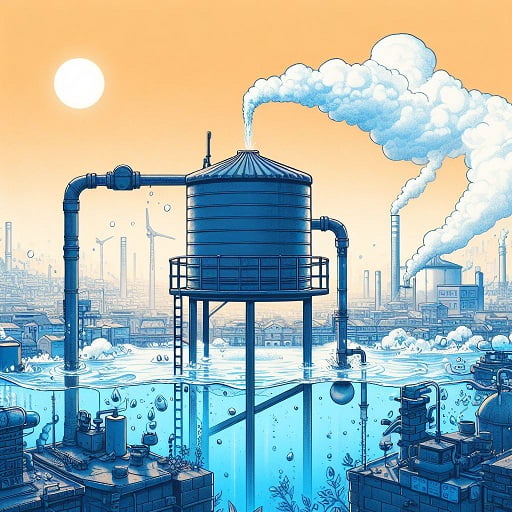
Industrialization affects Karachi’s water quality in three ways. Factories discharge untreated effluent into the Lyari and Malir rivers and the sea. Chemicals seep into the groundwater that bores and some tankers draw from. And industry and the population it attracts take a growing share of a supply that was never enough. Karachi generates about 472 million gallons of sewage and waste water a day, and only a small part of it is treated before it reaches the sea.
Karachi Tank Cleaning cleans tanks for factories as well as homes, so we see both ends of this: the water industry uses and the water families store. This article explains how the pollution happens, what it means for health, what the law says, and what a household or a business can realistically do.
Historical Perspective
At independence in 1947 Karachi was a port city of a few hundred thousand people. It became the country’s commercial capital, and industry followed. The Sindh Industrial Trading Estate (SITE) was laid out in the west of the city in the years after independence. Landhi and Korangi developed as industrial areas from the late 1950s and 1960s, followed by North Karachi and Federal B Area. Port Qasim and its surrounding industrial zone came in the 1970s.
Each estate was built for production: textiles, tanneries, chemicals, pharmaceuticals, steel, food, paints, oil. Treatment of what the factories discharged was left for later, and for the most part later did not arrive. The population grew past 20 million, housing spread around and between the industrial zones, and the two rivers that drain the city, the Lyari and the Malir, turned into open channels for sewage and industrial waste.
Factors Affecting Water Quality
Industrial Effluents
Karachi has eight industrial areas, and the waste water from their factories goes into the sea untreated, according to a 2022 report quoting the water board and WWF-Pakistan (Aaj News). What that effluent contains depends on the industry:
| Industry | Typical pollutants |
|---|---|
| Textile dyeing and finishing | Dyes, salts, caustic soda, detergents, high-temperature waste water |
| Tanneries | Chromium, sulphides, salts, organic matter |
| Chemicals, paints and pesticides | Solvents, acids, heavy metals, toxic organic compounds |
| Pharmaceuticals | Solvents, active drug residues |
| Oil refining and petrochemicals | Oil, grease, phenols |
| Metal plating and steel | Heavy metals, acids, cyanides |
| Food and beverage | Organic waste, fats, cleaning chemicals |
Effluent harms water in several ways at once. Organic waste uses up oxygen as it rots. Heavy metals and persistent chemicals accumulate in sediment and in fish. Salts and acids change the chemistry of rivers and groundwater. Hot discharges and dyes block light and kill what lives in the water.
Population Growth
Industry draws workers, and workers need housing, water and sewers. Domestic sewage is the larger part of Karachi’s waste water by volume, and it follows the same route as factory effluent. The demand side is as strained: the city needs about 1,200 million gallons of water a day and receives about 650 (Geo News).
Agricultural Runoff
Karachi’s main supply comes from the Indus through Keenjhar Lake and from the Hub Dam. The Indus carries fertiliser, pesticide and drainage water from farmland upstream, and the lake receives run-off from its own catchment. Vegetable farms along the Malir and Lyari rivers have long been irrigated with the polluted river water itself.
Climate Change
Heavier monsoon bursts flush accumulated waste out of nullahs and spread it across flooded neighbourhoods. Longer dry periods mean less water to dilute what is discharged. A rising sea pushes salt water into the coastal aquifer. See the impact of climate change on water tanks in Karachi.
Ageing infrastructure
Water and sewer lines run side by side under the same streets, and both leak. Because supply is intermittent, the water lines stand empty for long periods and draw in whatever surrounds them. This is how pollution that started in a drain ends up in a kitchen tap.
How Industrial Pollution Reaches Household Water
The sweet water in Karachi’s pipes is taken from the Indus and the Hub, well upstream of the city’s own industry. So industrial pollution does not usually enter at the source. It enters along the way.
- Boring water. Effluent in unlined drains and rivers seeps into the ground. Bores near industrial areas and along the Lyari and Malir can draw contaminated groundwater.
- Tanker water of unknown origin. Dawn’s 2023 investigation counted six official hydrants and at least 86 illegal ones (Dawn). Some tankers carry bore water. The buyer usually cannot tell.
- Leaking pipes. In industrial districts and the housing around them, contaminated ground and surface water enters cracked mains when pressure is low.
- Underground tanks. A cracked sump in polluted ground takes in whatever is around it. See detecting and preventing leaks.
- Air. Soot, dust and chemical fallout settle on roofs and in open tanks.
- Food. Vegetables irrigated with waste water and fish from polluted coastal water carry contaminants into the diet.
Impact on Human Health
Waterborne Diseases
The immediate danger in Karachi’s water is still sewage. Typhoid, hepatitis A and E, cholera and diarrhoea follow wherever waste water meets drinking water. When the Pakistan Council of Research in Water Resources tested 118 samples from the city in 2017, 107 were unsafe, and a third contained E. coli (Dialogue Earth). See waterborne diseases common in Karachi.
Long-term Health Effects
Chemical contamination works more slowly. Long exposure to heavy metals and industrial chemicals in water is associated with kidney and liver damage, nerve damage, some cancers, and harm to children’s development. Three points matter for a household:
- You usually cannot see, smell or taste it.
- Boiling does not remove it. Boiling kills germs. It leaves metals and salts behind and concentrates them slightly.
- Ordinary filters do not remove it. Sediment, ceramic and UV units have no effect on dissolved chemicals. Activated carbon removes many organic chemicals. Reverse osmosis removes most metals and salts. See filtration and cleaning in Karachi homes.
If you rely on a bore near an industrial area or a nullah, have the water tested by a laboratory for metals as well as bacteria before using it for drinking or cooking.
Case Studies and Statistics
- 472 million gallons a day. That is the sewage and waste water Karachi generates. A little over 10%, about 55 million gallons, was being treated, against an installed treatment capacity of 150 million gallons (Aaj News, June 2022).
- Treatment plants running below capacity. The same report found the plant at Gutter Baghicha (TP-1) treating about 20 million gallons a day against a capacity of 51, the Mauripur plant (TP-3) treating 35 against 54, and the Mehmoodabad plant (TP-2) not operating.
- Two rivers as drains. About 300 million gallons a day of untreated water reaches the sea through the Lyari River and about 200 million through the Malir River, according to WWF-Pakistan’s technical adviser quoted in that report.
- Unsafe drinking water. 90.7% of Karachi samples tested by PCRWR for the Sindh High Court’s judicial commission in 2017 were unfit to drink (Dialogue Earth). The Supreme Court removed the head of the water board the same year after the commission reported that the water supplied to Karachi and Hyderabad was substandard (Dawn).
- Unfiltered supply. In 2018, filtration plant officials told the commission that not even half of Karachi’s water was being filtered (ProPakistani).
- Salt in the aquifer. A 2025 study measured total dissolved solids of 1,550 to 4,920 mg/L in the groundwater of one Karachi locality and attributed it to seawater intrusion (Naseem and Bano). The national standard for drinking water is below 1,000 mg/L.
Environmental Consequences
Ecosystem Damage
The Lyari and Malir no longer function as rivers for most of their length through the city. They carry waste. Mangroves along the coast, which shelter young fish and protect the shore from storms, are stressed by pollution and reduced freshwater flow.
Impact on Aquatic Life
Untreated discharge strips oxygen from coastal water and loads it with metals and oil. Fish, shrimp and the fishing communities that depend on them bear the cost. Contaminants that accumulate in seafood return to people’s plates.
Soil Contamination
Land irrigated with waste water and ground soaked by leaking drains hold metals and salts for decades. Crops take some of it up. Rain washes the rest down into the groundwater.
Regulatory Measures and Policies
- Sindh Environmental Protection Act, 2014. No person may discharge waste or pollutants at levels higher than the Sindh Environmental Quality Standards. The Sindh Environmental Protection Agency administers and enforces the Act (summary).
- National Standards for Drinking Water Quality, 2010. These set the limits drinking water must meet, including no detectable E. coli, TDS below 1,000 mg/L and arsenic at or below 0.05 mg/L (S.R.O. 1063(I)/2010).
- The courts. The Supreme Court’s commission on water and sanitation in Sindh, from 2017, inspected treatment and filtration plants and ordered repairs and accountability.
- The utility. The Karachi Water and Sewerage Board became a corporation in 2023, with the mayor as chairperson (Dawn).
The laws are adequate on paper. Enforcement, treatment capacity and money are what is missing. More detail is in the role of government regulations on water quality in Karachi.
Community Involvement
- Residents can report illegal discharges and sewage mixing to the utility and the environmental agency, and can keep their own storage clean.
- Building unions, mosques and schools can schedule tank cleaning and testing and post the dates.
- Factories can treat effluent before discharge, keep drinking water tanks separate from process water, and maintain both.
- Universities and civil society are already working on reuse and recharge. A project led by NED University diverts used ablution water from more than 20 Karachi mosques into recharge wells (Arab News).
Technological Solutions
For industry
- Effluent treatment plants inside factories, and combined plants serving whole estates.
- Recycling and reuse of process water, which cuts both discharge and demand.
- Cleaner production: less water per unit, safer chemicals, chromium recovery in tanneries.
- Monitoring of discharge quality, with records.
Innovations in Water Purification
- Reverse osmosis for brackish and chemically contaminated water, at plant and household scale.
- Activated carbon for organic chemicals, taste and odour.
- Ultraviolet and ultrafiltration for germs.
- Low-cost sensors and test kits that let households check TDS and chlorine themselves.
For storage
Mechanical tank cleaning with pressure washers and vacuums, followed by measured disinfection, removes what settles in tanks between deliveries. See the role of technology in modern tank cleaning.
Tank Cleaning for Industrial and Commercial Sites
Factories store water for three purposes: drinking and canteen use, process and cooling, and fire-fighting. Each tank type has its own cleaning needs, and drinking water tanks on industrial sites are exposed to more dust and chemical fallout than those in residential areas.
Industrial jobs start with a free survey. Large and deep reservoirs need gas detection, ventilation, harnesses and a bigger crew, and we work under the client’s own site safety rules. Where a company requires a disinfectant from its approved list, we use it. Afterwards the client receives a cleaning certificate and a tax invoice for its auditors. Our own registrations and safety certification are on the certificates page. The safety procedure is on our safety page, and some of the organisations we have worked for are named on the clients page.
What Households Can Do
- Know your source. Line water, tanker or bore. If you buy tankers, ask where they fill.
- Test bore water for TDS, bacteria and, near industrial areas, metals.
- Treat drinking water to match the problem. Boil or use UV for germs. Use RO for salty or chemically suspect water.
- Keep the underground tank watertight and its cover raised and sealed.
- Clean both tanks every 6 months. See how often to clean your water tank.
- Keep lids on rooftop tanks to keep out dust and fallout.
Cleaning removes the sediment, biofilm and deposits where contaminants collect. It cannot change the chemistry of the water that arrives next, which is why source and treatment matter as well.
Future Outlook
The direction depends on three things: whether sewage and effluent treatment capacity is actually built and run, whether the environmental law is enforced on the industrial estates, and whether the supply gap narrows. Plans for all three exist and have existed for years. Until they are delivered, the practical burden stays with the people who use the water: factories treating what they discharge, and households and buildings controlling what they store and drink.
Frequently Asked Questions
How is industrialization responsible for water pollution?
Factories discharge waste water containing chemicals, metals, dyes and organic matter. Where it is not treated, it pollutes rivers, the sea and groundwater, and the people and housing that industry attracts add sewage to the same channels.
Is Karachi’s tap water affected by industrial waste?
The line supply is drawn upstream of the city’s industry, so its main problem is sewage contamination in the pipes. Industrial chemicals are more of a concern in bore water and in tanker water of unknown origin.
Does boiling remove industrial chemicals from water?
No. Boiling kills germs but leaves metals, salts and most chemicals in the water.
Which filter removes chemical contamination?
Reverse osmosis removes most dissolved metals and salts, and activated carbon removes many organic chemicals. A combined unit with both is the usual choice.
Do you clean industrial water tanks?
Yes. We clean drinking water tanks, reservoirs and large RCC tanks for factories and commercial sites after a free survey.
Tank Cleaning for Homes and Industry
Call or WhatsApp 0313-2796778. We work across Karachi, including the industrial districts of Korangi, Landhi, FB Area, North Karachi and the areas around SITE such as Baldia Town. House rates are on our charges page, and commercial and industrial sites are quoted after a free survey, which you can request through the contact page.
About the author: Ahmar Shoaib is the founder of Karachi Tank Cleaning. He holds a BS in Chemical Engineering from Karachi University and has run the company’s cleaning and disinfection work since 2007. This article follows our editorial policy.
Sources: Aaj News, Karachi’s dirty water flows to the ocean untreated (June 2022); PCRWR figures reported by Geo News (May 2025); Dawn Investigations, Karachi’s tanker mafia (January 2023); PCRWR testing (2017), reported by Dialogue Earth; Dawn (March 2017 and July 2023); ProPakistani (January 2018); Naseem and Bano, Impact of Seawater Intrusion on Coastal Aquifers of Karachi (2025); Sindh Environmental Protection Act, 2014; National Standards for Drinking Water Quality, S.R.O. 1063(I)/2010; Arab News (June 2025).