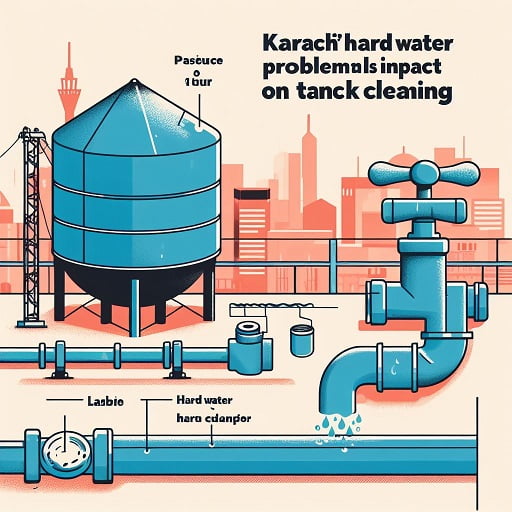
Yes, Karachi has hard water, but it depends on the source. Boring water across most of the city is very hard and often salty. Line water from the Indus and Hub systems is much softer. Most homes use a mix of both, plus tankers, so the scale in your tank tells you which source dominates. Hard water is not a health hazard in itself. Its cost is paid in scale: on tank walls, in geysers and pumps, and in the extra work it takes to keep a tank clean.
This guide explains what hardness is, how to tell if your water is hard, whether it is safe to drink, what it does to a water tank, and the treatments that work. Scaled tanks are a regular part of our work, so the tank is covered in detail.
Understanding Hard Water
What hardness is
Hardness is the amount of dissolved calcium and magnesium in water. Rain is soft. As water moves through soil and rock it dissolves minerals, so groundwater is usually harder than river water. Both the US Geological Survey and the World Health Organization use the same scale, measured as calcium carbonate:
| Class | Hardness (mg/L as calcium carbonate) |
|---|---|
| Soft | 0 to 60 |
| Moderately hard | 61 to 120 |
| Hard | 121 to 180 |
| Very hard | More than 180 |
Source: USGS. Pakistan’s National Standards for Drinking Water Quality set a limit of 500 mg/L for total hardness and 1,000 mg/L for total dissolved solids (S.R.O. 1063(I)/2010).
Hardness and TDS are not the same thing
Total dissolved solids (TDS) counts everything dissolved in the water, including sodium and chloride from salt. Hardness counts only calcium and magnesium. Karachi’s boring water is usually high in both: hard, and brackish. A TDS meter gives a quick overall reading, and a hardness test kit or a laboratory gives the hardness figure.
Does Pakistan have hard water?
Much of it does. Large parts of the country rely on groundwater, and groundwater is hard in many districts. Surface water from rivers and canals is softer. So the answer changes from city to city and from house to house, depending on whether the tap is fed by a river scheme or a bore.
Why Karachi’s groundwater is so hard
- Geology. The city sits on limestone and sandstone, which give up calcium and magnesium to the water passing through.
- Seawater intrusion. Heavy pumping draws the sea inland underground. A 2025 study of groundwater in one Karachi locality measured total dissolved solids between 1,550 and 4,920 mg/L, dominated by sodium and chloride, and concluded that it was severely affected by seawater intrusion (Naseem and Bano).
- Over-extraction. The city receives about 650 million gallons a day against a need of about 1,200 million (Geo News). Bores fill part of the gap, and the deeper they go, the saltier the water.
- A dry climate. Little rain reaches the aquifer to dilute it.
How to tell if your water is hard
- White crust on taps, shower heads and around the kettle element
- Soap and shampoo that will not lather, and a film left on skin
- White spots on glasses and steel after drying
- Stiff, dull laundry
- A white band at the waterline inside the tank
- A salty or bitter taste, if the water is brackish as well
For a number, use a TDS meter for a rough guide, test strips for hardness, or a laboratory test for both.
Is hard water safe to drink?
Hardness itself, yes. The WHO has not set a health-based guideline for hardness, stating that there are insufficient data to suggest either minimum or maximum concentrations (WHO). Calcium and magnesium are nutrients, and some studies link magnesium in drinking water with lower heart disease, though the WHO notes this does not prove cause.
Two cautions apply in Karachi. First, very hard water tastes unpleasant, and the taste threshold for calcium is 100 to 300 mg/L. Second, the water here is often salty as well as hard, and water above the national TDS standard of 1,000 mg/L is not suitable for drinking. Hardness also says nothing about bacteria. Hard water can be perfectly clear and still carry sewage germs.
Other effects people ask about
- Skin and hair: hard water leaves soap residue that can make skin feel dry and hair dull. It is a comfort issue, not a disease.
- Appliances: scale on heating elements wastes electricity and shortens the life of geysers, kettles and washing machines.
- Plumbing: pipes, valves and shower heads narrow and block over time.
Impact of Hard Water on Water Tanks
Scale on walls and floor
When hard water warms up or evaporates, calcium carbonate comes out of solution and sticks to the nearest surface. Rooftop tanks in Karachi’s heat scale faster than underground ones. The crust starts as a white haze and builds into a rough layer.
A home for bacteria
Scale is porous. Biofilm grows into it and is shielded from chlorine and from light scrubbing. A scaled tank is harder to disinfect than a smooth one. See bacteria in Karachi’s water tanks.
Jammed fittings
Float valves stick, so the tank overflows or fails to fill. Ball valves seize. Outlets narrow and pressure drops. See common water tank problems.
Pump damage
Scale coats the impeller and casing and reduces output. Brackish water corrodes cast iron and steel. See pump system maintenance.
Corrosion of the tank itself
Salts attack the steel reinforcement in concrete tanks and corrode galvanised and low-grade stainless steel tanks. See choosing the right tank material.
Hidden damage
A layer of scale over a concrete wall can cover a crack until the tank is leaking. See detecting and preventing leaks.
Challenges in Tank Cleaning
- Scale does not rinse off. Sludge and biofilm come away with water and pressure. Old scale is bonded to the surface.
- The obvious chemical is the wrong one. Hydrochloric acid dissolves scale quickly, and informal cleaners use it for that reason. It also dissolves cement, corrodes metal, gives off dangerous fumes in a closed tank and leaves residue in drinking water.
- Acid and chlorine must never meet. Together they release chlorine gas. Descaling and disinfection have to be separate steps with a full rinse between them.
- Concrete cannot take acid at all. Underground tanks, where scale is often heaviest, have to be descaled mechanically.
- It takes longer. A heavily scaled tank takes considerably longer than a normal job.
Modern Solutions for Tank Cleaning
- Drain and remove sludge so the scale is exposed.
- High-pressure washing at 2,000 to 3,000 PSI lifts loose and moderate scale from concrete and plastic without chemicals.
- Scraping with plastic tools on plastic tanks, so the wall is not scratched.
- A purpose-made descaler for heavy deposits, or food-grade citric acid on plastic and steel, applied to the scaled areas, left briefly and scrubbed.
- Complete rinsing and vacuum removal of every trace of descaler and loosened scale.
- Chlorine disinfection only after the rinse, followed by a final rinse.
We do not use harsh industrial acids in drinking water tanks. Safer options are compared in eco-friendly products for tank cleaning. The products we use are listed on our cleaning chemicals page, the steps are on the service procedure page, and the home method is set out in how to deal with hard water stains and deposits on tank walls.
How to Solve the Hard Water Problem at Home
| Treatment | What it does | Use it for | Limits |
|---|---|---|---|
| Reverse osmosis (RO) | Removes hardness, salt and most other dissolved solids | Drinking and cooking water from a bore | Wastes some water. Needs filter and membrane changes. |
| Ion-exchange softener | Swaps calcium and magnesium for sodium | Whole-house protection of geysers, pipes and tanks | Needs salt and servicing. Adds sodium, so not for drinking water that is already salty. |
| Scale inhibitor (polyphosphate cartridge) | Keeps minerals dissolved so they do not stick | The line to a geyser or washing machine | Does not remove hardness. Cartridge needs replacing. |
| Boiling | Removes some temporary hardness as scale in the pot | Small amounts for tea and cooking | Does not remove salt |
| Blending | Mixing bore water with softer line or tanker water | Reducing scale throughout the house | Depends on having sweet water available |
| Magnetic or electronic conditioners | Claimed to alter scale formation | Not recommended alone | Evidence is mixed. Do not rely on them. |
For most Karachi homes on boring water, the practical set-up is: sweet water kept separately for the kitchen where possible, an RO unit for drinking, an inhibitor on the geyser line, and tank cleaning on schedule. Filter choices are compared in filtration and cleaning in Karachi homes.
Maintenance Tips to Prevent Hard Water Buildup
- Separate your sources. Do not mix bore water into the tank that holds line water if you can keep two tanks.
- Shade the overhead tank. Cooler water deposits less scale.
- Keep the lid sealed to cut evaporation.
- Do not oversize the tank. Water that sits longer deposits more. See choosing the right size water tank.
- Check the float valve monthly and descale it in vinegar when it starts to stick.
- Soak aerators and shower heads in vinegar overnight every couple of months.
- Set the geyser thermostat no higher than you need. Scale forms fastest at high temperature.
- Choose smooth tank surfaces. White-lined plastic and well-plastered concrete give scale less grip.
The general routine is in how to maintain your water tank after cleaning.
The Importance of Regular Tank Cleaning
Scale that is a few months old comes off under a pressure washer. Scale that is several years old has to be chiselled, and the fittings under it may need replacing. That is the argument for a schedule.
We recommend cleaning every 6 months for all tanks, and every 4 to 6 months for homes that depend on boring water. Each cleaning also gets rid of the biofilm that scale shelters and gives you a look at the tank’s walls and fittings while they are bare. See how often you should clean your water tank in Karachi.
Future Outlook
Karachi’s groundwater is unlikely to get softer. As long as supply falls short, bores will multiply and deepen, and seawater will keep advancing under the coastal districts. Households in those areas should plan on treating bore water permanently and on choosing tank materials that tolerate salt. We look at the trend in the impact of climate change on water tanks in Karachi.
Two things would ease the problem: more sweet water in the pipes, which is the government’s job, and recharge of the aquifer with rain, which households and communities can contribute to. See the benefits of rainwater harvesting.
Frequently Asked Questions
Is Karachi’s tap water hard?
Line water is much softer than boring water, which is very hard and often salty. Many homes get a mix.
Is hard water safe to drink?
Hardness itself is not a health risk, and the WHO sets no health limit for it. Water that is also salty, above 1,000 mg/L TDS, or contaminated with bacteria is not safe, however hard or soft it is.
How do I know if my area has hard water?
If you use a bore, assume it is hard. Check for white crust on taps and inside the kettle, and confirm with a TDS meter or hardness test strips.
Does hard water cause hair fall?
It leaves mineral and soap residue that makes hair dry and brittle for some people. There is no good evidence that it causes permanent hair loss.
Does boiling remove hardness?
Partly. Boiling drives off the temporary hardness, which is the scale you see in the kettle. It does not remove salt or permanent hardness.
What TDS is acceptable for drinking?
Pakistan’s standard is below 1,000 mg/L. Most people prefer the taste below about 500.
How often should a tank on boring water be cleaned?
Every 4 to 6 months, before the scale hardens.
Scale Removal and Tank Cleaning in Karachi
Call or WhatsApp 0313-2796778. We clean and descale tanks across the city, including the coastal areas of DHA, Clifton and Keamari, where bore water is saltiest. Rates are on our charges page, and the calculator on the home page gives an instant rate for your house.
About the author: Ahmar Shoaib is the founder of Karachi Tank Cleaning. He holds a BS in Chemical Engineering from Karachi University and has run the company’s cleaning and disinfection work since 2007. This article follows our editorial policy.
Sources: US Geological Survey, Hardness of Water; WHO, Hardness in Drinking-water: background document for the Guidelines for Drinking-water Quality (2011); National Standards for Drinking Water Quality, S.R.O. 1063(I)/2010; Naseem and Bano, Impact of Seawater Intrusion on Coastal Aquifers of Karachi (2025); PCRWR figures reported by Geo News (May 2025).