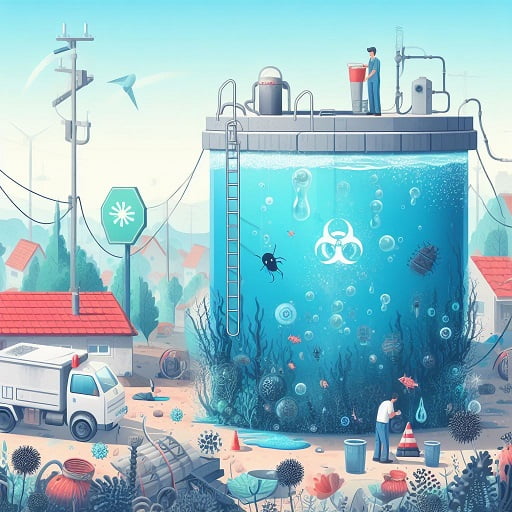
A water tank that is not cleaned does not stay the same. Sludge builds on the floor, a film of bacteria spreads over the walls, and the tank slowly turns from a store of water into a source of contamination. The result for the household is recurring stomach illness, foul-smelling water, a worn-out pump and, eventually, a tank that leaks. All of it is avoidable with a cleaning every 6 months.
This article follows a neglected tank through time and sets out what goes wrong at each stage.
Why Clean Water Tanks Matter
Karachi’s water reaches homes in bursts. Line supply runs for a few hours on set days, tankers fill the gaps, and many houses pump boring water as well. Everything waits in the underground and overhead tanks before use. The quality of that water at the tap depends as much on the state of the tanks as on the supply.
Supply quality is poor to begin with. When the Pakistan Council of Research in Water Resources tested 118 Karachi samples for a judicial commission in 2017, 107 were unsafe to drink (Dialogue Earth). A tank that is never cleaned collects what each of those deliveries leaves behind. The health background is in the importance of water tank cleaning for health and hygiene.
Common Neglect in Water Tank Cleaning
Tanks are neglected for ordinary reasons:
- Out of sight. The underground tank is under a cover in the porch and the overhead tank is on a roof nobody visits.
- The water looks fine. Bacteria are invisible, and water has to be badly contaminated before it changes colour.
- “We drink filtered water.” The filter treats one tap. The rest of the house runs on tank water.
- Nobody is responsible. In rented houses and apartment blocks, tenant, landlord and union each assume someone else will arrange it. See who is responsible for tank cleaning in apartment buildings.
- Fear of losing water. In a city with shortages, people hesitate to drain a tank. Cleaning just before supply day solves this, as explained in the best time to clean your water tank.
What Happens Inside a Neglected Tank
| Time since last cleaning | Inside the tank | What you notice |
|---|---|---|
| Up to 6 months | Thin layer of silt on the floor, light film starting on the walls | Usually nothing |
| 6 to 12 months | Sludge thick enough to be stirred up by each refill, slippery walls, first algae in tanks that let in light | Occasional cloudy water after refilling, filters clogging sooner |
| 1 to 2 years | Deep sludge that has started to rot, heavy biofilm, scale on walls and fittings, insects and larvae | Smell, colour, grit in buckets, stomach upsets that keep coming back |
| More than 2 years | Hardened deposits, corroded fittings, blocked outlets, possible cracks hidden under sludge | Low pressure, pump failures, leaks, visible worms or dead animals |
The timings vary with the water source. A tank filled by tankers or boring water reaches each stage sooner than one on line water.
Health Risks Associated with Neglecting Water Tank Cleaning
Stomach and liver infections
Sewage-borne germs cause typhoid, hepatitis A and E, cholera and diarrhoea. Sludge shelters these germs and keeps them alive between deliveries, so one contaminated supply can affect the household for weeks. Sindh has had an outbreak of extensively drug-resistant typhoid since late 2016, with most cases in Karachi (WHO). This strain does not respond to most of the usual antibiotics, which makes prevention more important than it used to be. See waterborne diseases common in Karachi.
Chlorine stops working
Rotting sludge and biofilm use up chlorine. Whatever disinfectant is left in line water, or added by the household, is gone within hours in a dirty tank. The bacteria inside the film are barely touched.
Naegleria
The amoeba Naegleria fowleri lives in warm fresh water that is poorly chlorinated and infects through the nose during bathing or ablution. Nearly everyone who develops the brain infection dies (CDC). Karachi recorded its third death of 2026 in July, and health experts again urged residents to chlorinate underground and overhead tanks (ARY News). A warm, sludgy, unchlorinated tank is the kind of place it survives in.
Other growth
Neglected tanks also grow algae, which taints the water and feeds bacteria, and can harbour Legionella, which infects the lungs through shower spray. Open or broken lids let in birds and lizards. We cover each of these in preventing algae growth, the Legionella threat and bird contamination in rooftop tanks.
Children pay first
UNICEF estimates that 53,000 children under five die in Pakistan every year from diarrhoea linked to poor water and sanitation (UNICEF Pakistan). In a household, the youngest child is usually the first to show that the water has gone bad. See how dirty tanks affect children’s health.
Damage to the Tank and Plumbing
- Pump wear. The pump draws from the bottom of the underground tank. Sand and grit grind down impellers and seals, and a blocked foot valve lets the motor run dry and burn out. See pump system maintenance.
- Stuck float valves. Scale and grit jam the float, so the tank overflows or fails to fill.
- Blocked pipes and taps. Sediment settles in horizontal runs, aerators and shower heads and cuts the flow.
- Corrosion and cracks. Sludge holds salts and moisture against concrete and steel. Damage under the sludge goes unseen until the tank leaks. See detecting and preventing tank leaks.
- Appliance damage. Geysers, washing machines and filters all collect the sediment a dirty tank sends them.
Hard water makes this worse. Boring water in much of Karachi leaves heavy scale, which we discuss in Karachi’s hard water problem.
Environmental Implications
Neglect wastes water. When a tank finally becomes unusable, it is usually full, and the whole volume has to be dumped. Leaks that go unnoticed under sludge lose water every day in a city that receives roughly half of what it needs (Geo News).
The waste itself is also harder to handle. Two years of rotting sludge is a larger and fouler load to dispose of than six months of silt. How that waste should be handled is covered in proper waste disposal after tank cleaning.
Legal and Regulatory Aspects
Pakistan’s National Standards for Drinking Water Quality say that E. coli and coliform bacteria must not be detectable in drinking water (S.R.O. 1063(I)/2010). Those standards are aimed at suppliers. We know of no regulation that sets a cleaning interval for a private household tank, so for homes the duty is a practical one, owed to your own family.
For anyone who supplies water to others, neglect carries real exposure:
- Landlords and building unions provide water to tenants and residents and will be the first people asked when a building falls ill.
- Restaurants, food factories, schools and hospitals are inspected, and their auditors ask for cleaning records. We issue a cleaning certificate and a tax invoice to commercial and industrial clients for this purpose.
- Employers are responsible for the drinking water they give their staff.
The broader framework is explained in government regulations on water quality in Karachi.
Importance of Regular Cleaning
Every problem in this article starts with build-up, and build-up takes time. Cleaning every 6 months resets the clock before the tank reaches the stage where it harms people or equipment. It also costs less: a lightly soiled tank is quicker to clean than a neglected one, and you avoid the pump, plumbing and medical bills that neglect brings.
If your tank has been ignored for a long time, the fix is the same. A full cleaning removes the sludge, strips the film, disinfects the surfaces and shows you the true condition of the tank. Our service procedure describes the steps, and how often to clean your water tank gives the schedule to follow afterwards.
Frequently Asked Questions
My tank has not been cleaned for years. Is it too late?
No. Hardened sludge and scale take longer to remove, but a tank in sound condition can be brought back to clean in one visit. If the cleaning reveals cracks or corroded fittings, have them repaired before the next refill.
Is the water dangerous if it still looks clear?
It can be. Clear water can carry bacteria. Smell and colour appear late, after contamination is well established.
Can I just add more chlorine?
No. Chlorine in a dirty tank is consumed by the sludge and film. It works only on surfaces that have been cleaned.
Will cleaning a very dirty tank cost more?
Our house rates are fixed by plot size or tank capacity and are listed on the charges page. The rate you are quoted is the rate you pay.
Do Not Leave It Longer
Call or WhatsApp 0313-2796778 at any hour. We clean tanks in every area of Karachi, including Orangi Town, Baldia Town and North Karachi, and you inspect the tank yourself before you pay, as set out in our service guarantee.
About the author: Ahmar Shoaib is the founder of Karachi Tank Cleaning. He holds a BS in Chemical Engineering from Karachi University and has run the company’s cleaning and disinfection work since 2007. This article follows our editorial policy.
Sources: PCRWR water testing for the Sindh High Court judicial commission (2017), reported by Dialogue Earth; WHO Disease Outbreak News, Typhoid fever in Pakistan (December 2018); CDC, About Naegleria fowleri infection; ARY News (July 2026); UNICEF Pakistan, WASH programme page; PCRWR figures reported by Geo News (May 2025); National Standards for Drinking Water Quality, S.R.O. 1063(I)/2010.