As a parent in Karachi, you already navigate a long list of health concerns for your children — smog, heat, traffic, and the general stress of raising a family in one of the world’s most densely populated cities. But one of the most serious, and most overlooked, threats to your child’s health may be hiding in plain sight: the water tank on your rooftop or underground sump in your building.
Children are not just small adults. Their immune systems are still developing, their organs are more vulnerable to toxic exposure, and the health damage from contaminated water can follow them for years — affecting their growth, cognitive development, school performance, and long-term organ health. Yet in most Karachi homes, the water tank goes uncleaned for months or even years.
This article breaks down exactly how a dirty water tank harms children, which diseases are most dangerous for young bodies, and what Karachi’s specific environmental conditions make the risk even higher — so you can make an informed decision to protect your family.
The Scale of the Problem: Karachi’s Children and Water Quality
Before looking at individual diseases, consider the broader context in which Karachi’s children are growing up:
| ~40% | of Karachi’s domestic water comes from private tankers with little to no quality regulation |
| #1 | Diarrheal disease is the leading cause of child death under age 5 in Pakistan — the majority waterborne |
| 70%+ | of water samples tested in Karachi’s low-income areas show fecal contamination |
| 6–8 wks | Average time for dangerous biofilm to form on an uncleaned tank surface |
| 2016 | Year Karachi became the origin point for the global XDR Typhoid outbreak — now affecting children worldwide |
Why Children Are Far More Vulnerable to Contaminated Water Than Adults
Many parents assume that if the whole family drinks the same water and the adults are fine, the children must be fine too. This reasoning is dangerously flawed. Here is why children bear a disproportionate burden from waterborne contamination:
1. Immature Immune Systems
A child’s immune system is not fully developed until around age 12–14. Before that, their bodies lack the antibodies and immune memory that adults have built up through years of exposure. The same bacterial load that causes mild discomfort in a healthy adult can trigger a life-threatening infection in a young child.
2. Higher Water Consumption Relative to Body Weight
Children drink significantly more water per kilogram of body weight than adults. This means that for every glass of contaminated water consumed, a child receives a proportionally higher dose of pathogens, heavy metals, and chemical contaminants.
3. Developing Organs Are More Susceptible to Damage
A child’s kidneys, liver, brain, and gut are all in active development. Heavy metals like lead and arsenic, which can leach into water from corroded pipes and tank walls, cause irreversible neurological damage in children — affecting IQ, attention span, emotional regulation, and academic performance — while causing minimal symptoms in adults at the same exposure level.
4. Children Spend More Time at Home
School-age children, infants, and toddlers spend the majority of their day in the home environment — drinking, bathing, and playing. They have more contact with household water than working adults who spend much of their day outside. This extended exposure amplifies risk.
5. Dehydration and Malnutrition Risk
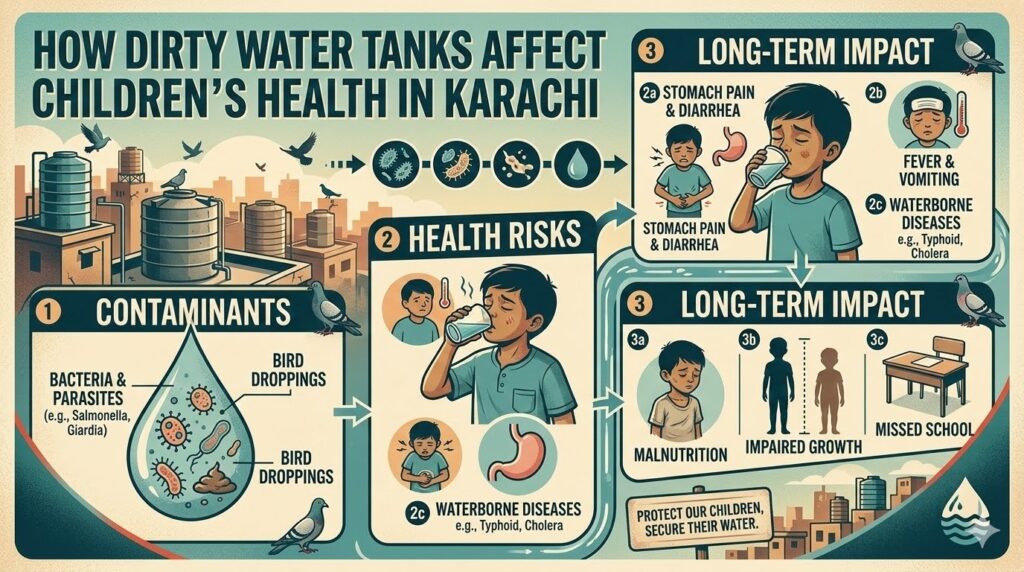
When children contract waterborne illnesses involving diarrhea and vomiting, they dehydrate far faster than adults. Dehydration in children under 5 can become critical within hours and is a leading driver of child mortality in Pakistan. Repeated bouts of diarrheal illness also cause chronic malnutrition, stunting physical growth and impairing brain development.
What this means for Karachi parents: Your children are not experiencing the same risk as you when they drink from an unclean tank. They are experiencing a significantly higher risk — and the consequences of illness are far more severe and potentially permanent.
Waterborne Diseases From Dirty Tanks That Are Most Dangerous for Karachi’s Children
🦠 Typhoid Fever — Including the XDR Strain
Typhoid is caused by Salmonella typhi bacteria entering drinking water through fecal contamination. In Karachi, this occurs when underground tanks develop cracks and allow surrounding sewage seepage to enter, or when tanker water is already contaminated at source.
In children, typhoid presents with sustained high fever (often 39–40°C for days), severe headache, abdominal distension, loss of appetite, and in serious cases, intestinal perforation requiring emergency surgery. Recovery without proper treatment can take 3–4 weeks — meaning weeks of missed school, developmental disruption, and high medical costs.
⚠️ XDR Typhoid Alert: The Extensively Drug-Resistant (XDR) Typhoid strain that originated in Karachi in 2016 is now the dominant strain in Pakistan. It is resistant to ampicillin, chloramphenicol, trimethoprim-sulfamethoxazole, fluoroquinolones, and third-generation cephalosporins. Children infected with XDR Typhoid require expensive, limited-availability antibiotics and face longer, more complicated recovery. Prevention through clean water storage is the most effective defence.
🦠 Hepatitis A — Acute Liver Disease in Children
Hepatitis A spreads via fecal-oral contamination of water — precisely the pathway enabled by a dirty, cracked, or inadequately sealed water tank. While adults sometimes experience mild or even symptom-free Hepatitis A infections, children can experience acute liver inflammation with jaundice (yellowing of skin and eyes), severe fatigue, dark urine, and abdominal pain lasting weeks.
Karachi sees regular Hepatitis A outbreaks, particularly during and after monsoon season. Children in schools and households drawing from shared tanks are especially at risk during these surges.
🦠 Acute Diarrheal Disease — The Silent Child Killer
Waterborne diarrheal diseases caused by E. coli, Shigella, Rotavirus, and Campylobacter are the most common consequence of contaminated tank water in Karachi. What may seem like a manageable stomach upset in an adult can be life-threatening in an infant or toddler.
The mechanism is straightforward: bacteria from tank sediment and biofilm enter drinking water. Children consume the water. Within 24–72 hours, diarrhea and vomiting begin. In children under 2, rapid fluid loss from diarrhea causes dehydration that can become critical within 6–8 hours.
The World Health Organization estimates that diarrheal disease kills a child somewhere in the world every 11 seconds — the vast majority in developing countries with water safety challenges exactly like those faced by Karachi families.
🦠 Giardia and Cryptosporidium — Parasites That Cause Chronic Illness
These parasitic organisms form hardy cysts that survive in water even after standard chlorination. They are introduced into tanks through cross-contamination with sewage or animal waste — a common occurrence in Karachi’s older residential areas where water and sewage lines run in close proximity.
In children, Giardia and Cryptosporidium cause chronic, recurring diarrhea, significant weight loss, abdominal bloating, and nutritional malabsorption. Because these parasites cause ongoing illness rather than a single acute episode, they are a major driver of chronic malnutrition and growth stunting in affected children. A child suffering repeated parasitic gut infections often falls behind in physical development and academic performance — impacts that persist long after the infection is treated.
🦠 Lead and Heavy Metal Contamination
This is a risk that many Karachi parents are completely unaware of. Older water tanks — particularly underground concrete sumps — can leach heavy metals including lead, arsenic, and manganese directly into stored water, especially as tank surfaces degrade and biofilm layers trap these metals.
For children, lead exposure has no safe threshold. Even very low blood lead levels in children are associated with permanent IQ reduction (estimated at 1–5 IQ points per 10 µg/dL increase), ADHD-like symptoms, aggressive behaviour, and poor academic outcomes. These are irreversible neurological changes — not symptoms that go away when the exposure stops.
Important: Unlike bacterial contamination, heavy metal poisoning from water has no obvious taste, smell, or colour. Your child may be drinking lead-contaminated water right now with no visible signs. Regular tank cleaning and inspection is the only way to identify and address this risk.
🦠 Skin, Eye, and Ear Infections
Children bathe more frequently than adults, and many younger children play in and around water. Bathing in water from a contaminated tank — particularly water with elevated Pseudomonas, Staphylococcus, or coliform bacteria — causes skin rashes, eczema flare-ups, eye infections (conjunctivitis), and ear infections (otitis externa). For children already prone to skin conditions or allergies, contaminated bath water can significantly worsen their symptoms.
Karachi-Specific Factors That Increase Your Children’s Risk
Karachi’s urban environment creates a combination of risk factors that are more severe than most other Pakistani cities. Understanding these helps explain why tank cleaning is not optional — it is a medical necessity:
🌧️ Monsoon Season: The Highest-Risk Period for Children
Every year between June and September, Karachi experiences flash flooding that overwhelms the city’s drainage infrastructure. Floodwater — carrying raw sewage, animal waste, chemical runoff, and solid debris — infiltrates both rooftop tanks (through vents and loose lids) and underground sumps (through soil seepage and cracked walls).
The weeks immediately following Karachi’s monsoon floods consistently see a dramatic spike in paediatric hospital admissions for diarrheal disease, typhoid, and hepatitis. This is not a coincidence — it is the direct result of flood water contaminating household tanks and children drinking from them.
If you have not scheduled a post-monsoon tank cleaning, your family has been drinking potentially flood-contaminated water for months. Book a professional tank cleaning and inspection as soon as possible.
🌡️ Extreme Heat Accelerates Bacterial Growth
Karachi’s summers regularly exceed 40°C. Black overhead plastic tanks on rooftops absorb this heat, raising internal water temperatures to 35–45°C — the optimal temperature range for rapid bacterial multiplication. A tank that is moderately contaminated in spring can become dangerously bacterially loaded by June.
Children who drink water stored in a heat-exposed, unclean rooftop tank during summer months may be consuming water with bacterial counts far exceeding safe thresholds — even if the tank appeared clean when last checked.
🚚 Tanker Water: An Uncontrolled Contamination Vector
An estimated 30–40% of Karachi’s domestic water supply comes from private water tankers. These tankers operate with minimal regulatory oversight. The water’s source, the tanker’s internal condition, and transit hygiene are all largely unverified. Multiple studies of Karachi tanker water have found coliform bacteria, E. coli, and other pathogens at levels that exceed safe drinking water standards.
When contaminated tanker water is loaded into an already-dirty tank, the bacterial load compounds rapidly. Families who rely entirely on tanker water and never professionally clean their tanks are placing their children in a high-risk situation every single day.
🏘️ Older Housing Stock and Aging Underground Tanks
Many of Karachi’s older residential areas — including parts of Saddar, Lyari, Orangi Town, Liaquatabad, and North Nazimabad — have underground concrete tanks that are decades old. These tanks frequently have hairline cracks, compromised inlet seals, and deteriorating surfaces that allow soil, groundwater, and sewage seepage to contaminate stored water.
Children living in these properties may be drinking water that has been in direct contact with contaminated soil or sewage-adjacent groundwater. This risk is invisible without a physical tank inspection.
🏫 School Tanks: A Community Risk
Your child’s school also has a water tank — and it likely faces the same maintenance neglect as residential tanks. Children at school drink from water fountains, wash their hands, and use bathrooms connected to the school’s tank supply. An unclean school tank creates a communal disease vector, where a single contamination event can sicken dozens of children simultaneously.
If you are a school administrator or facility manager reading this, professional water tank cleaning for commercial and institutional properties in Karachi is available and should be scheduled at minimum every quarter.
How Regular Professional Tank Cleaning Directly Protects Your Children
Every step of a professional cleaning process has a direct, documented impact on your children’s health outcomes:
- Biofilm removal eliminates the colonies of Salmonella, E. coli, and Legionella that chlorination cannot reach — the primary source of typhoid and diarrheal disease
- Sediment extraction removes the nutrient-rich layer at the tank floor where parasite cysts, bacteria, and heavy metals concentrate
- Algae eradication removes toxin-producing algae that cause skin irritation and gastrointestinal upset in children during bathing and drinking
- Disinfection kills residual viruses including Rotavirus and Hepatitis A — both of which are significant paediatric illness drivers in Karachi
- Crack and seal inspection identifies and flags entry points for external contamination, including the sewage seepage pathways most responsible for typhoid and hepatitis transmission
- Tank condition assessment identifies heavy metal leaching risks from deteriorating tank surfaces before irreversible neurological exposure occurs in children
The bottom line: A professionally cleaned tank directly reduces your child’s risk of typhoid, hepatitis, diarrheal disease, parasitic infection, and heavy metal poisoning — the five most significant water-related health threats facing children in Karachi.
For families who want to take this step, Karachi’s professional tank cleaning service provides end-to-end cleaning and inspection for overhead and underground tanks across all residential areas of the city.
Warning Signs Your Child’s Health May Already Be Affected
Sometimes contamination has already taken hold before parents realise the source. Watch for these patterns that may indicate your child is drinking from a compromised water source:
- Recurring unexplained fever — especially if it persists for more than 3–4 days
- Frequent or chronic diarrhea or stomach cramps — particularly if more than one child in the household is affected
- Unexplained weight loss or failure to gain weight in young children
- Jaundice (yellow tint to skin or eyes) in any family member
- Recurring skin rashes, especially following bathing
- Eye irritation or conjunctivitis occurring repeatedly
- Behavioural changes, attention difficulties, or academic decline without another clear cause (possible indicator of heavy metal exposure)
- Multiple family members experiencing gastrointestinal illness simultaneously
⚠️ If your child has been ill more than twice with fever, diarrhea, or vomiting in the past six months, and you cannot recall when your water tank was last professionally cleaned, the tank should be treated as a likely contributing factor. Consult a paediatrician and schedule an immediate tank inspection.
Recommended Tank Cleaning Schedule for Families With Children in Karachi
General guidelines recommend cleaning every 6 months. For Karachi families with children, we recommend the following schedule based on your specific situation:
- Every 3 months: Households with children under 5, families relying on tanker water, older properties with underground concrete tanks
- Before and after monsoon (June & October): Non-negotiable for all households — this is the highest-risk contamination window
- Immediately: If any family member shows signs of waterborne illness, or if you observe tank discolouration, odour, or visible algae
- Every 6 months minimum: Households on municipal supply in stable areas, with children over 12
- Quarterly: Schools, daycares, clinics, restaurants, and any facility where children consume water
Your Children Deserve Safe Water. Act Today.
Every day your water tank goes uncleaned is another day your children are exposed to typhoid bacteria, hepatitis viruses, gut parasites, and heavy metals. These are not abstract statistics — they are the documented reality of what is growing in neglected Karachi water tanks right now.
The solution is simple, fast, and far less costly than a single hospitalisation.
👉 Book Your Professional Tank Cleaning Now at karachitankcleaning.com →
Serving all Karachi neighbourhoods including DHA, Clifton, Gulshan-e-Iqbal, North Nazimabad, Gulistan-e-Johar, Korangi, Malir & beyond.
Same-week appointments available. Residential, commercial, and institutional properties.
Final Thought: The Cleanest Gift You Can Give Your Children
In a city where parents already worry about air quality, road safety, and educational access, water safety should not be an additional source of anxiety. But it must be an active priority — because it is one of the few health risks you have the power to eliminate almost entirely.
A professionally cleaned water tank does not just reduce illness. It protects your child’s developing brain, supports healthy growth, reduces school absences, and saves your family the emotional and financial cost of preventable hospitalisations.
Make the appointment today. Get your home’s water tank professionally cleaned in Karachi — and give your children the clean, safe water they need to grow, learn, and thrive.
Clean tanks. Healthy children. It starts with one decision.