
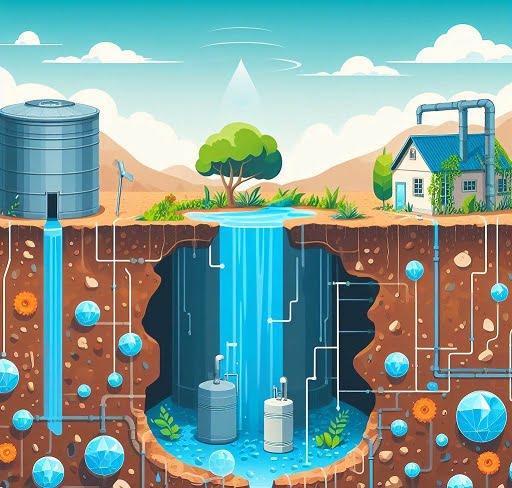
An underground water tank is the right choice for almost every house and building in Karachi, because it is the only practical way to catch low-pressure line supply and tanker deliveries. Its advantages are capacity, cool water and zero use of floor space. Its drawbacks are the risk of seepage and floodwater getting in, the need for a pump, and the difficulty of inspecting and cleaning a space you cannot see into.
We clean underground tanks every day, from 400-gallon house sumps to factory reservoirs, so this guide is written from inside them. It covers the pros, the cons, where to put one, what Karachi’s ground and climate do to it, and how to maintain it.
What Is an Underground Water Tank?
An underground tank, also called a sump, is a storage chamber built below floor level, usually under the porch, car park or courtyard. In Karachi it is normally reinforced concrete (RCC) or plastered blockwork with a concrete slab on top and a cover you can lift. Water arrives by gravity from the line, or from a tanker hose through the cover. A pump then lifts it to the overhead tank. For the other half of the system, see the benefits of overhead water tanks. All tank designs are compared in types of water storage tanks.
Underground plastic tanks also exist. These are thick-walled polyethylene tanks made to be buried. They suit small plots and avoid the cracking problem of concrete, but they must be bedded and backfilled exactly as the maker specifies, and an ordinary rooftop tank must never be buried, because soil pressure will crush it.
Pros of Underground Water Tanks
They fill without a pump
Line pressure in most of Karachi is too low to push water up to a roof. It will, however, run into a tank that sits below the level of the street main. An underground tank collects every hour of supply, including the weak flow at the start and end of each supply period.
They hold a lot of water
With supply every few days and tankers of 1,000 gallons or more, a house needs storage measured in thousands of litres. That volume is easy to build below ground and hard to carry on a roof. Sizing is covered in how to choose the right size water tank.
They take no usable space
The car parks on top of it. On small plots this is the deciding factor.
The water stays cool
Soil shields the tank from the sun. Water in an underground tank stays far cooler than water in a rooftop tank, which slows bacterial and algal growth. No light reaches it, so algae is rarely a problem unless the cover is left open.
They are built to last
A well-built RCC tank lasts as long as the house. It cannot blow over, crack in the sun or be damaged by a falling object.
They can take a tanker delivery
A tanker cannot pump to your roof. It needs an opening at ground level. If you ever expect to buy water, and in Karachi most households do at some point, you need an underground tank.
Cons of Underground Water Tanks
Contamination can seep in
This is the main risk. The tank sits in the same ground as sewer lines, soak pits and drains. A crack in the wall or floor, or a gap around a pipe, lets dirty groundwater in whenever the level outside is higher than the level inside. When the Pakistan Council of Research in Water Resources tested Karachi’s water in 2017, a third of samples contained E. coli from sewage (Dialogue Earth). Underground tanks are one of the places where that mixing happens.
Street water gets in from the top
If the cover is level with the floor, rainwater, car-wash water and anything spilled on the porch can run in around its edges. During monsoon flooding, a low cover can go completely under.
You need a pump and electricity
Water in the ground is useless until it is lifted. That means a motor, wiring, running costs and no water at the taps when the pump fails and the overhead tank is empty. See pump system maintenance and, for running it off the grid, solar-powered pumps.
Problems stay hidden
You cannot walk around an underground tank and look for damp patches. Leaks and cracks are usually found only when the tank is empty, which is one more reason to clean it on a schedule. See how to detect and prevent tank leaks.
Cleaning is harder and riskier
Sludge has to be lifted out because there is no drain at the bottom. The tank is also a confined space: air at the bottom can be low in oxygen or contain gas from decaying sludge. Nobody should go into one alone. Our safety page explains how our crews ventilate and enter.
Higher building cost
Excavation, steel, concrete, waterproofing and a slab strong enough to park on all cost money. The cost depends on capacity, soil, depth of the water table and the price of cement and steel at the time, so get quotations from two or three contractors and ask each to itemise waterproofing separately. It is the item most often skimped.
Summary
| Pros | Cons |
|---|---|
| Fills by gravity from low-pressure supply | Seepage from sewers and groundwater through cracks |
| Large capacity | Floodwater and wash water entering around the cover |
| Uses no floor space | Needs a pump and power |
| Cool, dark water with little algae | Leaks and cracks are hard to spot |
| Long life, protected from sun and wind | Confined space, harder to clean |
| Accepts tanker deliveries | Costs more to build than placing a plastic tank |
Suitable Locations for Underground Water Tanks
- Far from sewage. Keep the tank as far as the plot allows from septic tanks, soak pits, gutters and sewer lines, and never let it share a wall with any of them. Lay water pipes above sewer pipes where they cross.
- On the high side of the plot. Water should drain away from the cover, not towards it.
- Clear of foundations. Digging beside a footing can undermine it. A tank close to a boundary wall or column should be designed by a structural engineer, who will set the safe distance for your soil and structure.
- Near the street side. A short run from the main connection and easy reach for a tanker hose.
- Where the cover stays accessible. Not under a permanent structure, a planter or the spot where a car is always parked. Someone has to open it at least once a month.
- Close to the pump. Short suction pipes mean fewer priming problems.
A fuller treatment is in how to choose the right location for your water tank.
Considerations for Karachi’s Climate
Monsoon flooding
Karachi’s rain comes in short, violent spells. August 2020 brought 484 mm, the wettest August since 1931 (Wikipedia), and streets in many areas stayed under water for days. Build the tank’s neck 15 to 30 cm above the surrounding floor and fit a cover with a lip that sheds water. If floodwater does enter, stop using the water and have the tank cleaned and disinfected.
Salty ground and a high water table
Near the coast the groundwater is shallow and saline. A 2025 study of groundwater in one Karachi locality found total dissolved solids between 1,550 and 4,920 mg/L and concluded that it was severely affected by seawater intrusion (Naseem and Bano). Salts and sulphates in such soil attack ordinary concrete and rust the steel inside it. In coastal areas, engineers commonly specify sulphate-resisting cement and good external waterproofing. A high water table can also push an empty tank upwards, so the structure must be designed for it.
Heat
Heat is where underground tanks have the advantage. Being buried keeps the water cooler than any rooftop tank, which matters in a city where Naegleria fowleri, an amoeba that thrives in warm water, causes deaths most summers. The risk moves to the overhead tank, so both need cleaning and chlorination before the hot months. See the best time to clean your water tank.
Intermittent supply
Every time supply resumes after a gap, the first flow carries rust and silt from the pipes, and it all settles in the underground tank. Tanker deliveries add sand and stir up what is already there. This is why the underground tank is always dirtier than the overhead one.
Tips for Proper Maintenance
- Clean every 6 months, together with the overhead tank. Tanker-fed houses should clean every 4 months. See how often to clean your water tank.
- Open the cover once a month and look in with a torch. Check the colour of the water, the smell, and whether anything is floating.
- Keep the cover sealed and raised. Replace broken covers and fix the rubber or mortar seal.
- Keep the surroundings clean and dry. No car washing over the cover, no rubbish or pets around it.
- Inspect the inside whenever it is empty. Look for cracks, damp patches, tree roots and rusting steel. Have cracks sealed before refilling.
- Check the float valve so the tank neither overflows nor runs dry.
- Service the pump and keep the foot valve clear of sludge.
- Watch the water. A sudden smell or grey colour after supply resumes means sewage has mixed in the line. Do not wait for the due date.
The general routine is in how to maintain your water tank after cleaning, and troubleshooting is in common water tank problems.
How an Underground Tank Is Cleaned
The tank is pumped out, the sludge is removed from the floor, the walls and floor are pressure-washed, the waste water is vacuumed out, the surfaces are disinfected with a chlorine-based solution, and the tank is rinsed. A standard house takes 2 to 4 hours for both tanks. The full method is on our service procedure page.
For an underground tank alone, our house rates run from Rs 3,000 to Rs 9,000 depending on plot size. Cleaning both tanks in one visit costs less than two separate jobs. See water tank cleaning charges.
Legal and Regulatory Considerations
Building plans in Karachi are approved under the Karachi Building and Town Planning Regulations, and the water connection comes from the Karachi Water and Sewerage Corporation. Check both before you build or enlarge a tank, and follow your approved plan. We are not aware of any rule that sets how often a private tank must be cleaned. The water you store should still meet the national drinking water standards, which require that no E. coli or coliform bacteria be detectable (S.R.O. 1063(I)/2010). More background is in government regulations on water quality in Karachi.
Frequently Asked Questions
Is an underground water tank safe for drinking water?
Yes, if it is watertight, properly covered and cleaned every 6 months. The danger comes from cracks and badly sealed covers, not from being underground.
What is the main disadvantage of an underground water tank?
The risk of contamination from sewage or floodwater, combined with the fact that damage is hidden. Regular cleaning and inspection deal with both.
Can an underground tank be built next to a wall?
It can, but excavation beside a foundation is a structural matter. Have an engineer decide the distance and design. Do not let a contractor guess.
Concrete or plastic for an underground tank?
Concrete for most houses and all large tanks. A purpose-made underground plastic tank is an option for small capacities. Never bury an ordinary rooftop tank.
How often should an underground tank be cleaned?
Every 6 months, and every 4 months if it is filled mainly by tankers.
Why does my underground tank smell?
Usually rotting sludge on the floor or sewage that has entered through the line or a crack. Both need a full cleaning, and the second needs the leak found and fixed.
Underground Tank Cleaning Across Karachi
Call or WhatsApp 0313-2796778 for underground tank cleaning anywhere in the city, including FB Area, North Nazimabad and Gulberg. You can get an instant rate from the calculator on our home page.
About the author: Ahmar Shoaib is the founder of Karachi Tank Cleaning. He holds a BS in Chemical Engineering from Karachi University and has run the company’s cleaning and disinfection work since 2007. This article follows our editorial policy.
Sources: PCRWR water testing for the Sindh High Court judicial commission (2017), reported by Dialogue Earth; Naseem and Bano, Impact of Seawater Intrusion on Coastal Aquifers of Karachi, International Journal of Economic and Environmental Geology (2025); Wikipedia, 2020 Karachi floods; National Standards for Drinking Water Quality, S.R.O. 1063(I)/2010.