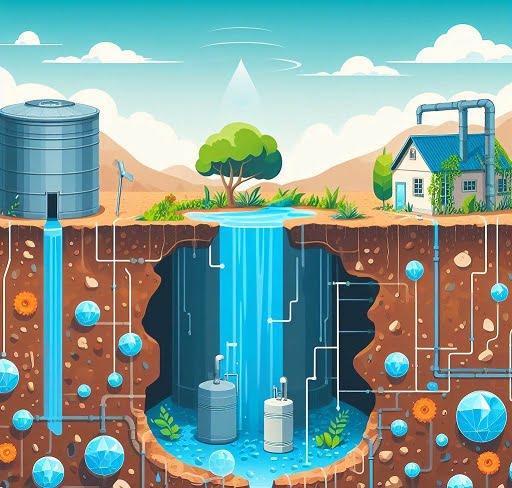

Water storage tanks are grouped in two ways: by position (underground, overhead or ground-level) and by material (concrete, plastic, fibreglass or steel). A typical Karachi house uses two types together: an underground concrete tank that receives the supply and an overhead plastic or concrete tank that feeds the taps.
We clean every one of these types, in houses, apartment blocks and factories, and each has its own strengths and its own way of getting dirty. This guide describes them from that practical angle so you can choose well and know what upkeep to expect.
Types of Water Storage Tanks
Underground tanks
An underground tank, also called a sump, sits below floor level, usually under the porch or car park. In Karachi it is almost always reinforced concrete or plastered blockwork. Its job is to catch water whenever it arrives: low-pressure line supply flows into it by gravity, and tankers empty into it through the cover.
- Strengths: large capacity, takes no usable space, keeps water cool, fills without a pump.
- Weak points: cover at floor level lets in street water, cracks let in groundwater or sewage, a pump is needed to lift the water, and entry for cleaning is a confined-space job.
Full details: pros and cons of underground water tanks.
Overhead tanks
An overhead tank sits on the roof or on a raised stand and supplies the house by gravity. Most new houses use plastic tanks. Older houses and apartment buildings often have concrete tanks built into the roof structure.
- Strengths: steady pressure without running the pump for every tap, water available during load-shedding, easy to inspect.
- Weak points: full sun heats the water, lids crack or blow away, birds and dust get in, and the weight needs a sound roof.
Full details: benefits of overhead water tanks.
Ground-level tanks
These stand on a plinth at ground level. They are common in factories, farms and commercial sites, and in houses where digging is not possible. They are easy to install and inspect, but they take up space and need a pump for both filling the house and, sometimes, for pressure.
Loft and intermediate tanks
Tall buildings sometimes add break tanks on middle floors or small loft tanks inside flats. They reduce pressure on lower floors and give each flat a reserve. They are also the tanks most often forgotten at cleaning time.
Tanks for special purposes
- Fire-fighting reservoirs in factories and large buildings hold water that may stand unused for years. They still need periodic cleaning, because stagnant water corrodes the system and breeds bacteria.
- Process and cooling water tanks in industry are cleaned to the plant’s own schedule.
- RO and filter storage tanks in homes are small pressurised tanks that should be sanitised yearly. See filtration and cleaning in Karachi homes.
- Tanker trucks are mobile storage tanks. Their cleanliness matters as much as your own tank’s.
Material Considerations
Reinforced concrete (RCC)
Concrete is the standard for underground tanks and for large overhead tanks on buildings. It is strong, long-lasting and can be built to any size. Its surface is slightly rough and porous, so biofilm and algae hold on more firmly than on plastic. Hairline cracks develop with age and ground movement. Concrete tanks should be plastered smooth inside, waterproofed, and inspected for cracks at each cleaning.
Plastic (polyethylene)
Rotationally moulded polyethylene tanks dominate rooftops in Karachi. They are light, rust-free, quick to install and sold in sizes from a few hundred litres to several thousand. Quality varies a great deal:
- Single-layer tanks are the cheapest. Thin or light-coloured ones let sunlight through, and algae follows.
- Multi-layer tanks usually have a UV-stabilised outer layer, a black middle layer that blocks light, and a white food-grade inner layer that makes dirt easy to see. Some add a foam layer to keep the water cooler. In Karachi’s sun, a layered tank is worth the extra cost.
Plastic tanks become brittle after years of sun. Lids are the first part to fail.
Fibreglass (GRP)
Glass-reinforced plastic tanks are rigid, light and do not corrode. They are made as one-piece tanks and as bolted panel tanks for large capacities on commercial roofs. Unlined or thin fibreglass lets light in, and old tanks can shed fibres from the inner surface when the lining wears, so the inside should have a smooth gel coat in good condition.
Stainless steel
Stainless tanks are hygienic, smooth and block all light. They cost more and heat up quickly in the sun unless insulated. Near the sea, low-grade stainless pits and rusts at the welds. They are common in food and pharmaceutical plants.
Galvanised and mild steel
Older rooftops still have galvanised iron tanks. Once the zinc coating wears through, they rust, and rust flakes end up in the water. Mild steel tanks in factories need an internal coating and regular inspection. If you have a rusting steel tank on a house, plan to replace it.
Comparison at a glance
| Material | Best used for | Main cleaning issue | Watch for |
|---|---|---|---|
| Concrete (RCC) | Underground tanks, large building tanks | Biofilm and scale grip the rough surface | Cracks, seepage, worn plaster |
| Multi-layer plastic | House overhead tanks | Silt on the floor, film on walls | Cracked lids, brittle body with age |
| Single-layer plastic | Low-budget or temporary use | Algae from light getting through | Thin walls, short life in sun |
| Fibreglass | Commercial roofs, panel tanks | Algae if translucent | Worn inner lining, leaking panel joints |
| Stainless steel | Food, pharma, premium homes | Scale shows clearly but wipes off | Weld corrosion near the coast |
| Galvanised steel | Legacy installations | Rust mixed with sludge | Perforation, rust in water |
For a deeper comparison, including what suits Karachi’s coastal air and hard water, read how to choose the right material for your water tank.
Application and Usage
- Houses: one underground concrete tank plus one overhead tank. Capacity depends on family size and how many days pass between supplies. See how to choose the right size water tank.
- Apartment buildings: large shared underground tanks and one or more roof tanks, sometimes with separate tanks for boring water. Responsibility for cleaning them is a regular source of disputes, covered in who is responsible for tank cleaning in apartment buildings.
- Commercial buildings, schools, hospitals and mosques: concrete or panel tanks sized for heavy daily use.
- Factories: process water tanks, fire-fighting reservoirs and drinking water tanks, often very large RCC reservoirs. Some of the organisations whose tanks we have cleaned are listed on our clients page.
- Rainwater tanks: separate tanks that collect roof run-off for washing and gardening. See the benefits of rainwater harvesting.
Environmental Impact
The tank that lasts longest has the smallest footprint. A well-built concrete tank can serve for the life of the house. A good multi-layer plastic tank outlasts two or three cheap ones, and polyethylene can be recycled at the end of its life. Stainless steel is fully recyclable.
Placement matters as well. A shaded or insulated overhead tank keeps water cooler, which slows bacterial growth and reduces the amount of disinfection needed. Leaks waste more water than anything else, so a sound tank is the greenest tank. See detecting and preventing leaks.
Choosing the Right Water Storage Tank
- Start with your water source. Line and tanker water need an underground tank to receive them. A house on boring water alone can manage with overhead storage.
- Work out the capacity. Count people, daily use and days between supplies. Our sizing guide shows the arithmetic.
- Match the material to the position. Concrete below ground, multi-layer plastic or concrete on the roof.
- Check the roof. A 1,000-litre tank weighs a tonne when full. Place it over a beam or column, not mid-slab.
- Think about access. You will need to open, inspect and clean this tank twice a year. A manhole a person can pass through and a lid you can reach are not optional.
- Choose the spot. See how to choose the right location for your tank.
What to check when buying a plastic tank
- Hold a torch against the wall. No light should come through.
- Look for a white, food-grade inner layer with no strong plastic smell.
- Press the wall. It should feel stiff.
- The lid should screw or clamp on and have a seal.
- The outlet should be moulded in, above the base.
- Buy from an established maker with a written warranty.
Installation and Safety
- Set plastic tanks on a flat, fully supported base. A tank resting on its edges will crack.
- Fit a tight lid, and mesh on the vent and overflow.
- Put the outlet a few centimetres above the floor so sediment stays in the tank instead of the pipes, and fit a drain or washout at the lowest point if you can.
- Keep underground tanks well away from soak pits, septic tanks and sewer lines, and raise the cover above floor level so rainwater cannot run in.
- Wash and disinfect any new tank before first use. Method: how to disinfect a water tank.
- Never enter an underground tank alone. It is a confined space. See our safety page.
How Each Type Is Cleaned
The method is the same for all types: drain, remove sludge, pressure-wash, vacuum, disinfect, rinse. What changes is the effort. Smooth plastic and stainless release dirt quickly. Rough concrete needs more washing and a close look at every corner. Scale from hard water needs extra work whatever the material, as described in dealing with hard water stains and deposits.
Whatever the type, we recommend cleaning every 6 months. See how often to clean your water tank and our service procedure.
Frequently Asked Questions
Which type of water tank is best for a house in Karachi?
For most houses, an underground concrete tank to receive supply and a multi-layer plastic overhead tank to feed the taps. That combination suits intermittent line supply and tanker deliveries.
Are layered plastic tanks really better?
Yes, in a hot, sunny city. The black layer stops light and so stops algae, the outer layer resists UV, and the white inner surface makes dirt visible.
Is a concrete overhead tank better than plastic?
Concrete keeps water cooler and lasts longer, but it is heavy, must be designed into the structure, and can crack and seep. Plastic is lighter, cheaper and easier to replace.
Do different tank types need different cleaning schedules?
No. Every type collects silt and biofilm. Clean all of them every 6 months, and sooner if they are filled by tankers or boring water.
Need a Tank Cleaned?
We clean plastic, concrete, fibreglass and steel tanks of every size. Call or WhatsApp 0313-2796778, or check our charges. We work across Karachi, including newer developments such as Bahria Town, Scheme 33 and Gulshan-e-Maymar. The full list is under service areas.
About the author: Ahmar Shoaib is the founder of Karachi Tank Cleaning. He holds a BS in Chemical Engineering from Karachi University and has run the company’s cleaning and disinfection work since 2007. This article follows our editorial policy.